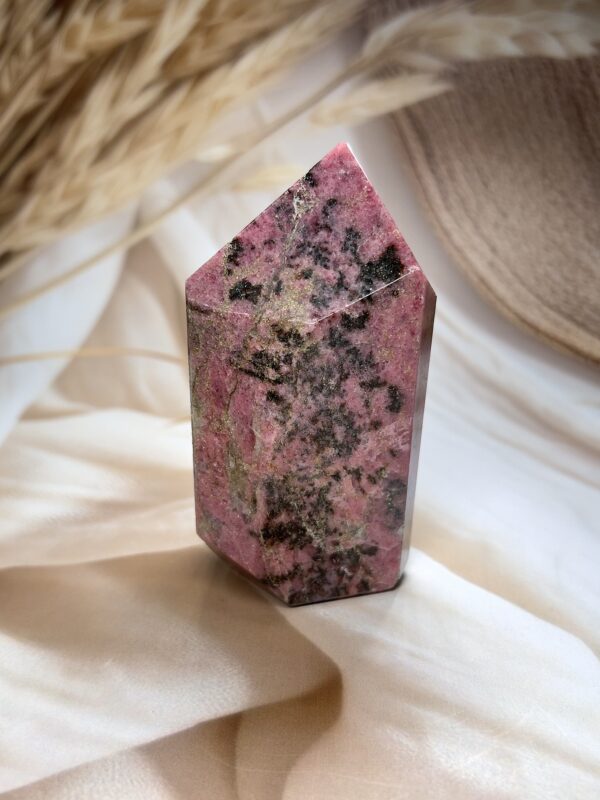
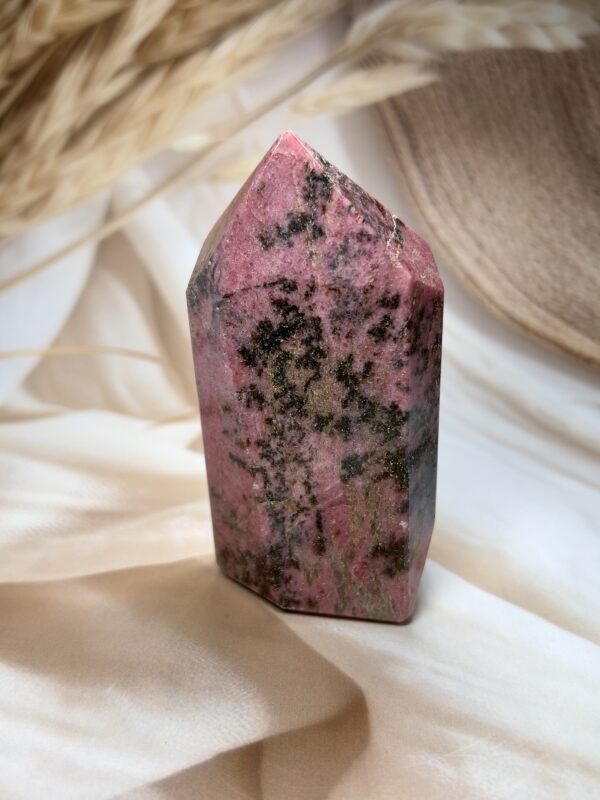
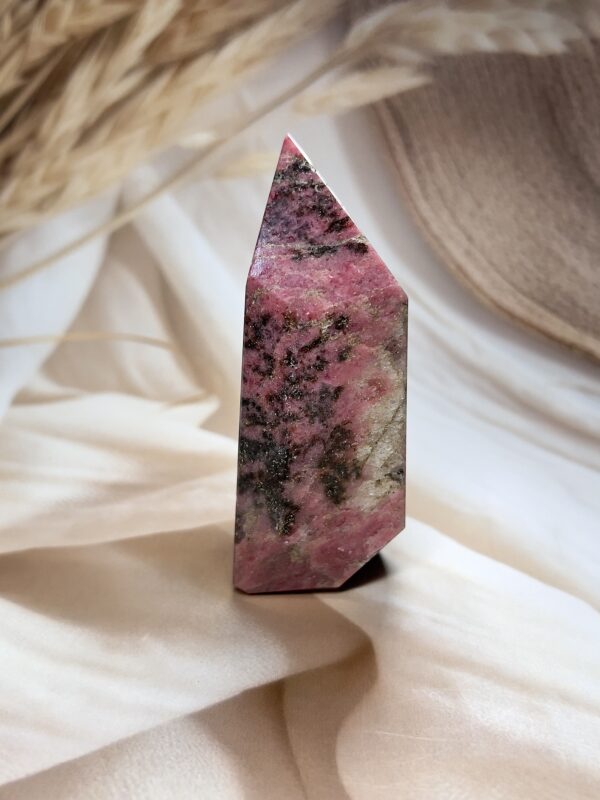
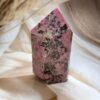
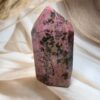
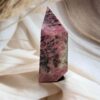
Deep Rose Colour. Dramatic Manganese Patterning. Natural Mineral Character.
This is a particularly beautiful example of Rhodonite, and what makes it stand out immediately is the saturation of the pink.
The body of the stone carries a strong, deeply coloured rose-pink tone, rather than a pale or washed-out appearance. Running through that pink are intricate black to very dark manganese-rich markings, creating a natural contrast that gives the entire freeform an almost hand-painted appearance.
The patterning is wonderfully organic:
Dense black clusters in some areas.
Fine branching marks in others.
Longer dark bands crossing the pink body.
Subtle changes in pink intensity from one surface to another.
This is exactly the kind of natural patterning that makes Rhodonite so appealing as a freeform.
At approximately 9.77 CM high, the carving has a tall, elegant profile, while its 5 CM length and 3.87 CM widthprovide enough surface area for the stone’s colour and markings to remain the centre of attention.
It weighs approximately 375 GM, giving it a substantial presence in the hand and on display.
What Is Rhodonite?
Rhodonite is a genuine manganese-rich pyroxenoid mineral. Its ideal composition is commonly simplified to MnSiO₃, although natural Rhodonite contains substitutions involving elements such as calcium, magnesium and iron. It crystallises in the triclinic system.
Its name comes from the Greek rhodon, meaning rose, a direct reference to its characteristic pink colour. Rhodonite was first described from the Ural Mountains, and the stone has a long history as an ornamental and carving material.
Rhodonite commonly occurs as massive or granular material, and its beautiful pink varieties are used for cabochons, beads, carvings, spheres, sculptures and other ornamental objects.
The Black Patterning
The dark markings are one of Rhodonite’s most recognisable visual characteristics.
Classic Rhodonite commonly occurs with black manganese-oxide material cutting through or contrasting against its pink body.
That produces the familiar combination of:
Rose-Pink + Black Manganese
The contrast can range from tiny dark specks to extensive black branching and vein-like areas.
Your freeform has a particularly attractive balance: the pink remains dominant, while the dark mineral patterning creates definition across the face of the stone.
The result is much more visually complex than a uniformly pink piece.
Why This Freeform Is So Attractive
The beauty of this piece comes from the relationship between its shape and mineral pattern.
A perfectly symmetrical carving would give the stone a predictable appearance.
This freeform does the opposite.
Its irregular outline allows the natural pink and black patterning to remain visually dominant, while the pointed upper section gives the piece a strong vertical silhouette.
It also provides several different faces to appreciate.
Turn it slightly and the balance of pink and manganese changes.
Turn it again and a different section of the natural pattern comes forward.
The shape lets the geology remain the star.
Physical Properties of Rhodonite
Rhodonite has a Mohs hardness of approximately 5.5–6.5, depending on composition, and has perfect cleavage in two directions, with good cleavage on another plane. Its density is approximately 3.57–3.76 g/cm³.
Its relatively low hardness and perfect cleavage are important practical characteristics.
Rhodonite can be polished beautifully, but it is not a gemstone that should be treated like Quartz.
Beautifully ornamental, but deserving of gentle handling.
Rhodonite in Traditional Crystal Practice
Rhodonite has one of the clearest identities in modern crystal traditions as a stone for the heart with grounding.
It is traditionally associated with:
- Emotional healing
- Compassion
- Forgiveness
- Self-love
- Self-worth
- Relationship harmony
- Emotional balance
- Courage
- Grounding
- Vitality
- Resilience
- Personal growth
It is often differentiated from stones used purely for romantic symbolism because its traditional emphasis is on working through emotional difficulties and becoming stronger without becoming emotionally closed.
These are traditional crystal-healing associations and are not scientifically proven effects.
Chakra Associations
Heart Chakra • Anahata
Love • Compassion • Forgiveness • Emotional balance
Rhodonite’s primary traditional chakra association is the Heart Chakra. It is commonly used in crystal practices focused on love, emotional healing, compassion, forgiveness and healthier relationships.
For practical everyday intentions, this is the side of Rhodonite associated with:
letting go of resentment, rebuilding self-worth, becoming more compassionate, and maintaining healthier emotional connections.
Root Chakra • Muladhara
Grounding • Stability • Security • Courage
Rhodonite is also traditionally associated with the Root Chakra. This adds steadiness to its otherwise strongly heart-centred symbolism.
The traditional Heart + Root combination is particularly useful symbolically:
Feel deeply without losing your grounding.
Care for others without abandoning yourself.
Stay open while maintaining boundaries.
Traditional Metaphysical Benefits
Emotional Healing
Rhodonite is traditionally used for working through emotional hurt, disappointment and unresolved feelings rather than simply pushing them aside.
Forgiveness
One of its strongest traditional themes is forgiveness—both forgiving others and releasing excessive self-blame.
Self-Love & Self-Worth
It is commonly chosen for rebuilding confidence, dignity, self-respect and a healthier relationship with oneself.
Relationship Harmony
Rhodonite is traditionally used to encourage understanding, compassion, patience and healthier emotional interaction.
Emotional Balance
Its Heart-and-Root symbolism makes it particularly suited to remaining emotionally open while staying grounded.
Courage
Traditional Rhodonite practice also emphasises the courage to confront uncomfortable emotions rather than continuously avoiding them.
Resilience
It is associated with recovering emotional strength after difficult experiences.
Healthy Boundaries
Rhodonite’s grounding association adds an important practical theme: compassion does not require self-neglect.
Personal Growth
It is traditionally used as a stone for turning difficult experiences into greater self-awareness and emotional maturity.
Traditional Physical & Body Associations
For customers interested in the physical side of crystal traditions, Rhodonite has a number of established traditional body correspondences. These should be understood as lithotherapy beliefs rather than scientifically demonstrated effects.
Heart & Circulatory System
Rhodonite is traditionally associated with the heart and circulation, corresponding to its Heart Chakra identity.
Blood
Some traditional systems associate Rhodonite with blood and blood flow, particularly within older manganese- and red-stone healing traditions.
Lungs & Breathing
Traditional crystal-healing references commonly connect Rhodonite with the lungs and respiratory system.
Nervous System
Rhodonite is traditionally used for emotional stress and is associated in lithotherapy with nervous-system balance and calming.
Liver
Some traditional sources specifically associate Rhodonite with the liver and the body’s cleansing processes.
Metabolism
Traditional crystal-healing systems also associate Rhodonite with metabolic activity and physical vitality.
Joints & Physical Recovery
Some traditional systems associate it with joints, inflammation and physical recovery.
Important Health Note
There is no reliable scientific evidence that Rhodonite treats heart disease, improves circulation, changes blood chemistry, treats lung or nervous-system disorders, improves liver function, alters metabolism, or repairs joints. These are traditional crystal-healing correspondences only and should not be presented as medical treatment.
What Makes This Particular Rhodonite Different
The strongest feature of this piece is its pink saturation.
Some Rhodonite specimens appear muted, dusty or predominantly grey.
This one is much more visually expressive.
The main body carries a strong organic rose-pink, while the manganese markings create a dramatic dark network over the surface.
That gives the piece a very appealing contrast:
Soft colour + strong pattern
Heart-centred symbolism + grounding mineral character
Natural irregularity + clean freeform shape
This is precisely the kind of Rhodonite that works beautifully as a display specimen, because its natural patterning can be appreciated from across the room and up close.
Why the Freeform Shape Works
The pointed upper section gives this piece a subtle sense of upward movement, while the broad base allows it to stand securely.
Unlike a sphere or symmetrical tower, the freeform doesn’t impose a repetitive geometric structure on the material.
Instead, it allows the natural manganese patterning to dictate the visual composition.
The result feels organic rather than manufactured.
The stone looks shaped, but not over-designed.
Where to Place Your Rhodonite Freeform
Bedroom
A particularly fitting location for traditional intentions around self-love, emotional healing, forgiveness and relationship harmony.
Meditation Space
Place it nearby during meditation, journaling or emotional reflection when focusing on the Heart Chakra and grounding.
Workspace
Useful as a symbolic reminder to maintain self-worth, emotional composure and healthy boundaries while dealing with everyday pressure.
Living Room
The saturated pink and dark natural patterning make it an attractive decorative focal point, particularly against neutral interiors.
Crystal Collection
At 9.77 CM tall and 375 GM, this has enough substance to sit comfortably among larger mineral freeforms, towers and statement specimens.
A Simple Intention for This Stone
For someone who wants a practical intention rather than elaborate ritual language:
“I can be compassionate without losing my strength.”
That captures the traditional Heart + Root identity of Rhodonite particularly well.
Specifications
Product: Rhodonite Freeform
Stone: Natural Rhodonite
Approx. Weight: 375 GM
Approx. Dimensions: 5 × 3.87 × 9.77 CM
Shape: Freeform
Colour: Rich, saturated organic rose-pink
Natural Patterning: Black / dark manganese-rich markings
Finish: Polished
Type: Natural Mineral Freeform / Collector’s Piece
Care Guide
Rhodonite is relatively soft at approximately Mohs 5.5–6.5 and has perfect cleavage, so avoid treating it like a Quartz or Agate freeform.
- Place on a stable, level surface.
- Handle with both hands when moving a larger freeform.
- Avoid dropping or striking the pointed top or edges.
- Clean gently with a soft, slightly damp cloth.
- Avoid abrasive materials.
- Keep away from harsh chemicals and acidic cleaners.
- Do not use ultrasonic or steam cleaners.
- Store separately from harder gemstones to minimise scratching.
- Avoid sudden temperature changes.
Reviews
There are no reviews yet.