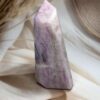
Premium Kunzite Freeform
Vibrant Pink Colour • Tall Freeform Profile • 468 GM
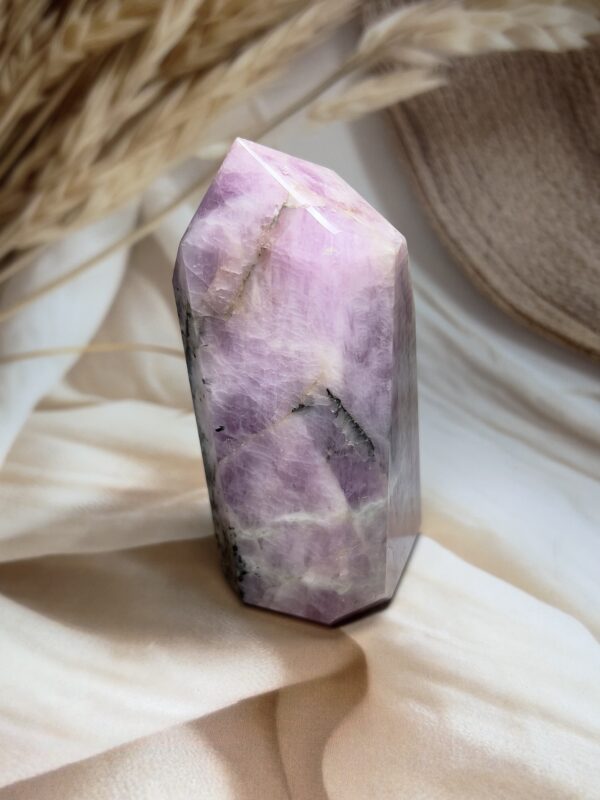
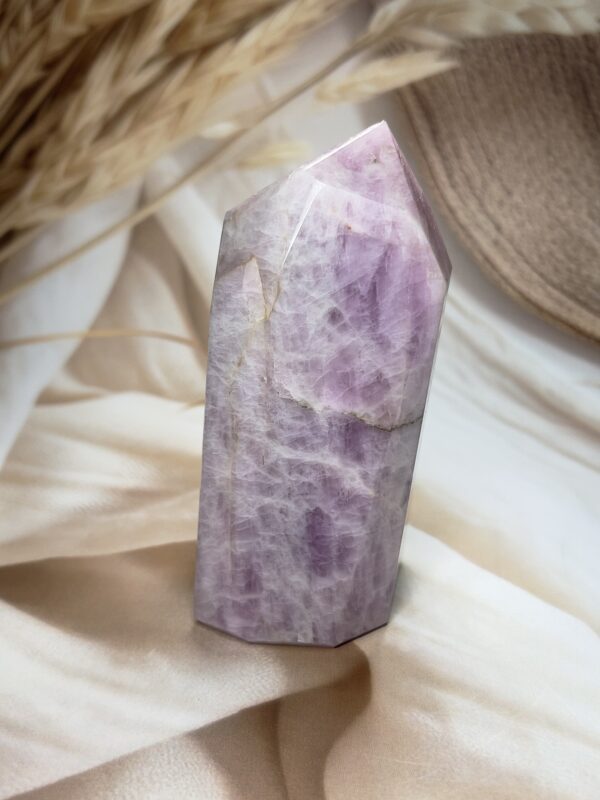
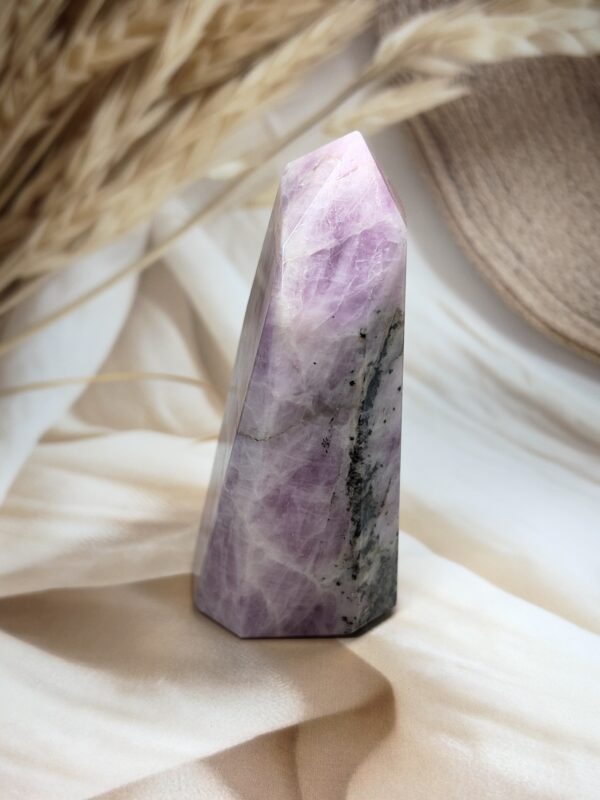
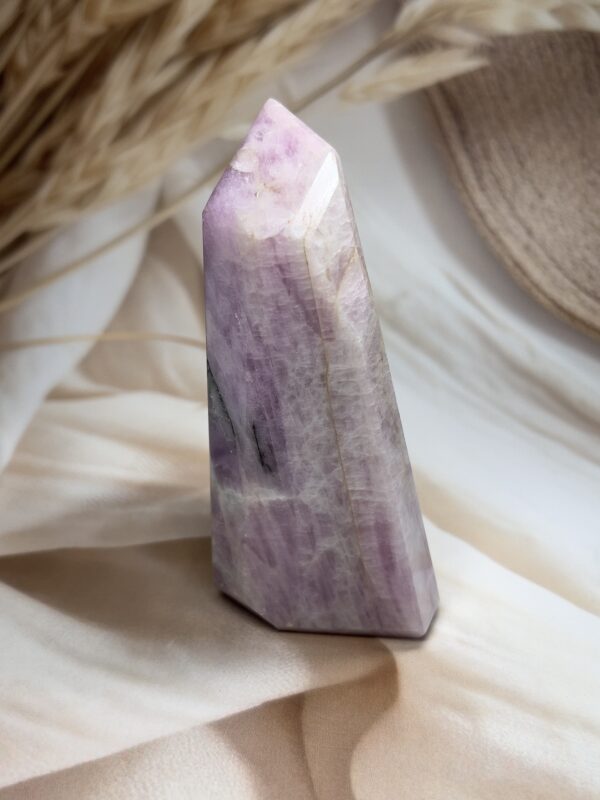
This is an exceptionally attractive Kunzite specimen, distinguished first and foremost by its strong, saturated pink appearance.
The pink is not limited to one carefully presented face. It can be seen across the different visible surfaces of the freeform, giving the specimen an impressive presence from multiple viewing angles.
At approximately 11.4 CM in height, the freeform has a tall, elegant profile, while its 5.6 CM length and 5 CM widthprovide a substantial base and enough surface area for the natural colour and internal character of the stone to remain prominent.
With a weight of approximately 468 GM, this is a substantial mineral specimen suited to a dedicated crystal collection, display cabinet, meditation space, bedroom, office or carefully curated interior.
The attraction of this piece is very straightforward:
Strong colour. Generous size. Beautiful natural form.
What Is Kunzite?
Kunzite is the pink to violet variety of Spodumene, a lithium aluminium silicate mineral with the chemical composition LiAlSi₂O₆. Its characteristic pink and violet colours are produced by trace amounts of manganese.
Kunzite was first recognised as a distinct gemstone variety around 1902 in San Diego County, California, and was named after gemologist George Frederick Kunz.
Today, Kunzite is particularly appreciated for its:
- Beautiful pink to violet colour
- Strong pleochroism
- Glassy lustre when well polished
- Large crystal sizes
- Distinctive elongated crystal habit
- Attractive appearance in both natural and fashioned forms
GIA notes that Kunzite can occur in very large sizes and that colour is its most important value factor, with more vivid colour generally being more desirable.
The Vibrant Pink Colour
The defining feature of this specimen is its vivid pink colour.
Kunzite commonly ranges from delicate pastel pink through stronger pink and violetish purple shades. Among these, stronger and more vivid colour is generally considered more desirable from a gemological perspective.
This specimen has been selected for its particularly attractive vibrant pink appearance, making the colour itself one of its strongest collector qualities.
The tall freeform also gives the colour room to remain visually prominent rather than being confined to a small polished cabochon or jewellery-sized stone.
The colour is the first thing that draws the eye, while the freeform shape keeps the specimen distinctly natural.
Kunzite’s Pleochroism
Kunzite is pleochroic, meaning that it can display different colour intensities, or slightly different colour appearances, when viewed along different crystallographic directions.
This is one of its most interesting optical characteristics.
A Kunzite crystal can therefore look stronger and more saturated from one direction while appearing lighter or subtly different when turned. GIA notes that the strongest colour is generally seen when looking down the length of the crystal, which is an important consideration when Kunzite is cut or oriented.
For a freeform, this produces a natural change in appearance as the specimen is viewed from different directions.
The stone does not need to look identical from every angle—the variation is part of Kunzite’s optical character.
Colour Across Multiple Sides
A collector’s freeform is naturally viewed from more than one direction, so colour distribution matters.
This particular Kunzite displays its vibrant pink character across multiple visible surfaces, allowing the specimen to maintain its visual appeal when placed on a shelf, display cabinet or table and viewed from different angles.
That makes it especially suitable for display rather than being dependent on one carefully selected “front.”
Turn the piece and the character of the colour changes with it.
A Substantial Kunzite Specimen
Large Kunzite crystals are known to occur, so size alone should not be described as making every large specimen rare. What makes an individual specimen desirable is the combination of colour, size, form, clarity and overall visual quality. GIA specifically notes that large Kunzite is not unusual and that vivid colour is the most important value factor.
This specimen combines:
468 GM weight
11.4 CM height
Vibrant pink colour
Colour visible across multiple sides
A tall freeform silhouette
That combination makes it particularly attractive as a collector-oriented Kunzite specimen.
The Freeform Shape
The freeform presentation allows the natural character of the Kunzite to remain visible without imposing a highly geometric shape over it.
Its tall profile gives the specimen a strong vertical presence, while the irregular edges retain a more natural mineral appearance.
Kunzite itself commonly occurs in elongated, flattened or blade-like crystals, so the vertical proportions of this freeform complement the mineral’s natural visual character.
Unlike a jewellery stone where the material is primarily viewed through a single finished surface, a freeform allows the stone’s colour, internal character and form to be appreciated together.
Why This Is a Collector’s Piece
This specimen is particularly suited to collectors who value colour-rich natural mineral forms.
The attraction is not based on an artificial grade or an unsupported rarity claim.
It comes from the actual characteristics of this individual piece:
Vivid pink colour
Substantial 468 GM weight
11.4 CM vertical height
Colour present across multiple sides
Natural freeform presentation
Together, these qualities give the piece the visual presence expected from a larger display specimen.
It can stand independently as a feature within a mineral collection rather than functioning merely as a decorative accent.
Kunzite in Crystal Traditions
In modern crystal-healing traditions, Kunzite is strongly associated with the Heart Chakra, with additional connections to the Crown Chakra.
Its traditional symbolism centres around bringing emotional awareness and inner understanding together.
Kunzite is traditionally associated with:
- Love
- Compassion
- Self-love
- Self-worth
- Emotional balance
- Forgiveness
- Inner peace
- Emotional resilience
- Intuition
- Creativity
- Calmness
- Spiritual awareness
- Healthy emotional expression
Traditional crystal sources particularly associate Kunzite with easing emotional barriers, encouraging self-compassion, supporting calmness and helping connect the heart with the mind.
These are traditional crystal-healing and spiritual associations and are not scientifically established medical effects.
Chakra Associations
Heart Chakra — Anahata
Love • Compassion • Self-Worth • Emotional Balance
The Heart Chakra is Kunzite’s strongest traditional chakra association.
It is traditionally used for intentions involving:
self-love
compassion
forgiveness
emotional healing
healthy relationships
emotional openness
acceptance
Kunzite’s traditional Heart Chakra symbolism is particularly suited to people working on the relationship they have with themselves as well as their relationships with others.
Rather than simply representing romance, it is commonly used as a symbol of emotional openness with self-respect.
Crown Chakra — Sahasrara
Spiritual Awareness • Reflection • Inner Understanding
Kunzite is also traditionally connected with the Crown Chakra, particularly because of its pink-to-violet colour range and its association with spiritual awareness and contemplation.
This creates a traditional Heart-to-Crown connection:
Heart — Feel
Crown — Understand
Symbolically, the two together represent responding to emotions with greater awareness rather than being controlled entirely by them.
Traditional Metaphysical Benefits
Emotional Calm
Kunzite is traditionally regarded as a soothing stone for emotional tension and is often used during periods of stress or emotional overload.
Self-Love
It is commonly chosen as a reminder of self-worth, self-care and self-acceptance.
Compassion
Its Heart Chakra association makes it traditionally suitable for cultivating compassion toward both yourself and others.
Forgiveness
Kunzite is frequently used in crystal practices centred around releasing resentment and moving beyond emotional hurt.
Relationship Harmony
It is traditionally associated with understanding, tenderness, honest emotional expression and maintaining healthier relationships.
Emotional Resilience
Kunzite is used symbolically to remain emotionally open without becoming overwhelmed by difficult experiences.
Inner Peace
Its traditional calming symbolism makes it popular for quiet reflection and meditation.
Intuition
Through its Crown Chakra association, Kunzite is traditionally connected with intuition, inner awareness and deeper reflection.
Creativity
Traditional Kunzite practices also associate it with creative expression and allowing emotions to move into constructive forms.
Spiritual Awareness
It is commonly used during meditation and contemplative practices focused on a broader sense of awareness.
Gentle Confidence
Kunzite’s traditional approach to confidence is based more on self-acceptance and emotional security than force or dominance.
Traditional Physical & Body Associations
Crystal-healing traditions also give Kunzite several physical correspondences. These are traditional energetic associations, not scientifically proven effects.
Heart & Circulatory System
Kunzite is traditionally associated with the heart and circulatory system, corresponding with its Heart Chakra symbolism.
Nervous System
Traditional crystal practices commonly associate Kunzite with a calmer nervous state and emotional relaxation.
Head & Brain
Its Crown Chakra association leads some traditions to connect Kunzite with the head, brain and mental activity, particularly around calmness, reflection and concentration.
Throat
Some crystal-healing systems associate Kunzite with the throat because of its traditional connection with honest emotional expression and communication.
Hormonal / Endocrine System
Some traditional lithotherapy systems associate Kunzite with the endocrine system and hormonal cycles.
Reproductive System
Traditional sources also associate Kunzite with the reproductive system, particularly through its connection with feminine energy and emotional cycles.
Muscular Tension
Some traditions use Kunzite symbolically for releasing physical tension associated with emotional stress.
Important Health Note
There is no reliable scientific evidence that Kunzite treats heart or circulatory conditions, nervous-system disorders, hormonal problems, reproductive conditions, mental-health conditions or muscular disorders.
These body associations belong to traditional crystal-healing and lithotherapy practices and should not be interpreted as medical treatment or as evidence that the stone changes the function of these organs.
Practical Everyday Intentions
Kunzite’s traditional symbolism can be kept simple and practical.
For Emotional Stress
Use the stone as a physical reminder to pause before reacting and give yourself time to process what you are feeling.
For Relationships
Keep it nearby during journaling or reflection around communication, compassion and healthier emotional boundaries.
For Self-Worth
Use it as a reminder that caring for yourself is part of maintaining healthy relationships with others.
For Personal Change
Its Heart-to-Crown symbolism can represent staying emotionally open while developing a clearer perspective.
For Meditation
Use the specimen as a visual focus for quiet reflection, self-compassion and emotional balance.
Why the Pink Colour Makes This Piece Particularly Attractive
Pink Kunzite has a naturally elegant appearance, but stronger colour creates considerably more visual impact.
This specimen’s rich pink saturation, combined with its large freeform profile, means the colour remains the dominant feature even when the stone is viewed from a distance.
Up close, the viewer can appreciate the natural internal character of the mineral.
From farther away, the strong pink silhouette gives the piece immediate visual presence.
It works at both levels: mineral specimen and interior display piece.
Where to Display It
Mineral Collection
Its size, colour and natural freeform shape make this the most obvious setting for a dedicated specimen display.
Living Room
A shelf, console or display cabinet allows the tall profile and vibrant colour to become a refined focal point.
Bedroom
A suitable personal placement for those who connect with Kunzite’s traditional Heart Chakra associations of self-love, emotional peace and compassion.
Meditation Space
Particularly suited to meditation, journaling, reflection and Heart-and-Crown-focused practices.
Workspace
A meaningful symbolic addition for maintaining calmness, thoughtful communication, self-worth and emotional balance throughout the day.
Display Tip
Choose a location with good ambient or controlled lighting rather than prolonged intense direct sunlight. Kunzite’s colour can fade with prolonged exposure to strong light, and high heat can also damage the stone. (GIA)
Physical Properties of Kunzite
Kunzite is the pink-to-violet variety of Spodumene, with the chemical composition LiAlSi₂O₆ and a hardness of approximately 6.5–7 on the Mohs scale.
However, hardness does not mean the stone is impact-proof.
Kunzite has two perfect cleavage directions, giving it relatively poor toughness. A strong impact or pressure applied in the wrong direction can cause the material to split.
The stone is also sensitive to heat and prolonged intense light, which can cause fading or, in the case of sudden temperature changes, physical damage.
These characteristics make Kunzite particularly suitable for careful display rather than rough handling.
Specifications
Product: Premium Kunzite Freeform
Stone: Natural Kunzite / Pink Spodumene
Approx. Weight: 468 GM
Approx. Dimensions: 5.6 × 5 × 11.4 CM
Shape: Freeform
Colour: Vibrant Pink
Colour Distribution: Visible across multiple sides
Mineral: Spodumene — Kunzite Variety
Chemical Composition: LiAlSi₂O₆
Hardness: Approximately 6.5–7 Mohs
Type: Premium Mineral Freeform / Collector’s Piece
Care Guide
Kunzite requires careful handling because its perfect cleavage and poor toughness make it more vulnerable to impact than its Mohs hardness alone would suggest.
- Place securely on a stable, level surface.
- Support the main body with both hands when moving it.
- Never lift the freeform by a narrow edge or pointed section.
- Avoid dropping, striking or knocking the specimen.
- Keep it away from shelf edges and locations where it could easily be tipped.
- Avoid prolonged exposure to intense direct sunlight.
- Keep away from strong heat sources.
- Avoid sudden temperature changes.
- Clean gently using a soft cloth.
- Mild soapy water can be used when necessary.
- Avoid abrasive materials and harsh cleaning chemicals.
- Do not use ultrasonic or steam cleaners.
- Store separately from harder minerals to minimise surface scratching.
Reviews
There are no reviews yet.