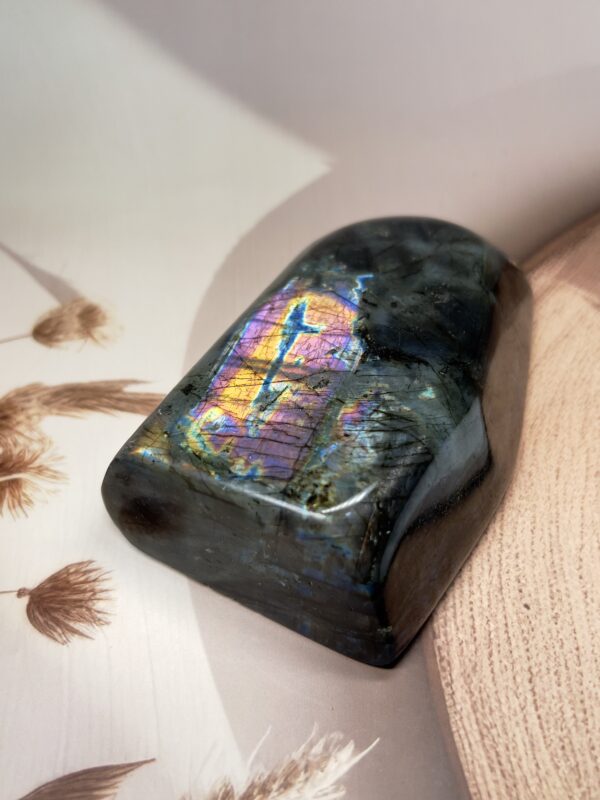
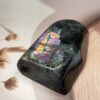
A Remarkable Display of Blue, Gold, Violet & Rainbow Labradorescence
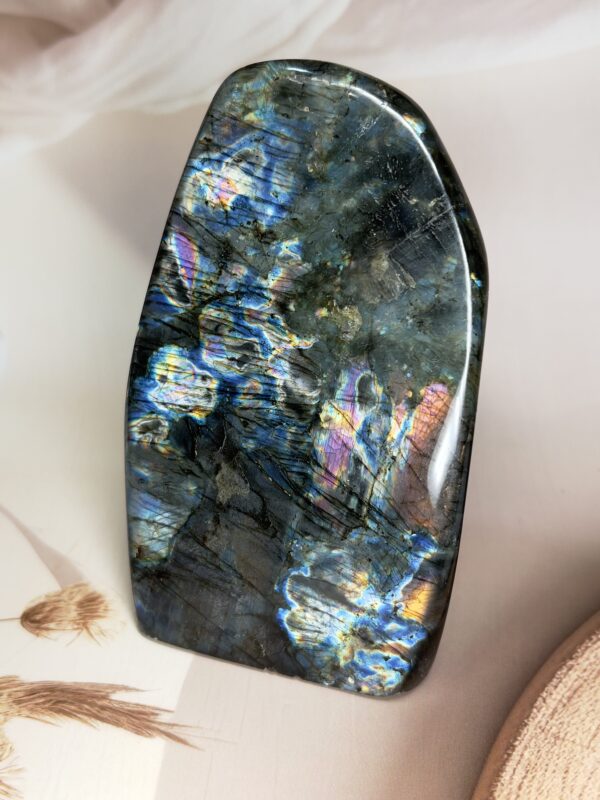
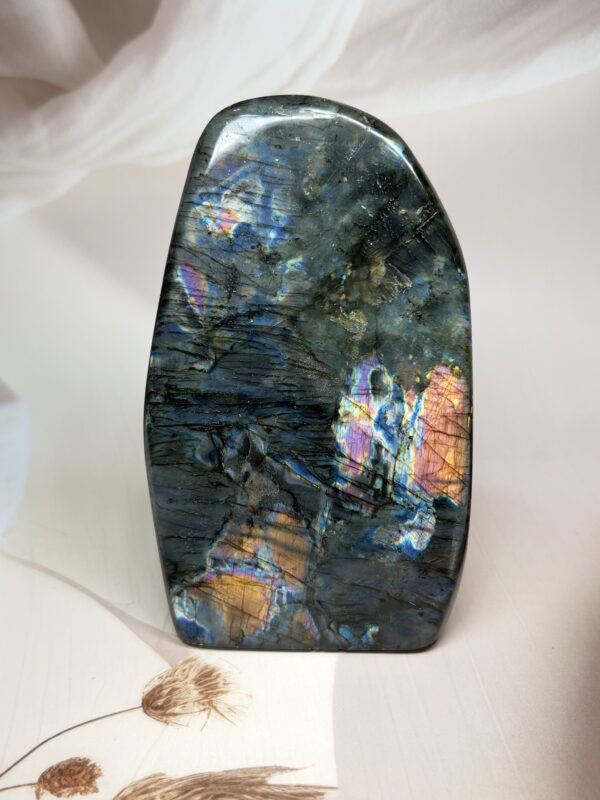
This Labradorite is notable for the sheer amount of colour revealed across its surface.
Its natural body is predominantly deep charcoal-grey to black, providing the perfect backdrop for extensive labradorescence. Across the polished face, the stone opens into numerous bright zones of:
Electric Blue
Royal Blue
Golden Yellow
Warm Gold-Orange
Violet / Purple
Pink
Green
And importantly, the colour is not confined to one small flash window.
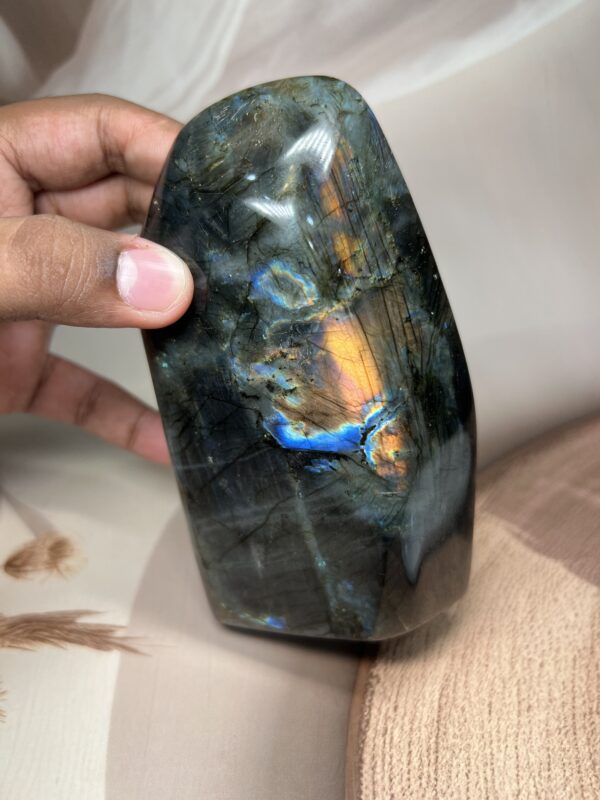
The photographs show multiple distinct active areas distributed across the freeform, with some zones displaying a combination of colours at the same time. There are also areas where blue borders transition into gold and violet, giving the surface an almost iridescent mosaic appearance.
This is exactly what makes the piece so visually impressive.
The stone looks dark until the light reaches it.
Then entire sections of the surface suddenly illuminate.
What Makes This Labradorite Special?
Labradorite’s defining optical phenomenon is called labradorescence.
GIA explains that it is produced when light interacts with extremely thin internal layers within the feldspar, creating broad flashes of colour that change as the stone or light moves. Typical labradorite most commonly shows blue and green, while yellow, orange and violet can also occur.
That makes your particular piece especially interesting because the photographs show a broad multi-colour presentation rather than predominantly blue-only flash.
GIA’s 2025 research further explains that the colour is related to the thickness of alternating feldspar lamellae: different thicknesses produce different portions of the visible spectrum. Blue occurs around thinner structures, while increasing thickness can produce progressively different colours through the spectrum.
In other words, the rainbow is geological.
It is being produced from inside the stone itself.
The Colours in This Particular Piece
Electric Blue
Blue is the colour most strongly associated with classic Labradorite labradorescence and is one of its most familiar visual signatures.
This piece has several areas where the blue appears particularly saturated against the dark body.
Golden Yellow & Gold
The warm golden flash gives the stone a very different character from conventional blue Labradorite.
Gold labradorescence is recognised in gemological literature and can occur when the internal feldspar layering produces longer-wavelength reflected colours.
Our piece has unusually prominent golden areas, particularly toward the central-right and lower sections.
Orange
Warm orange is less commonly the first colour people associate with Labradorite, but GIA specifically documents orange among the possible labradorescent colours.
Here, the orange appears alongside gold and violet, creating much richer colour transitions.
Violet & Pink
These colours give the stone an especially unusual appearance.
GIA’s recent research confirms that Labradorite can display the spectrum through to violet and red-range colours, depending on its internal lamellar structure.
How Unusual Is Multi-Colour Labradorite?
It is important to make a distinction between rare-looking and formally rare.
Labradorite itself is not an exceptionally rare mineral. GIA describes it as a relatively inexpensive plagioclase feldspar that is widely used in both gemstones and architectural material.
What becomes much more desirable is the quality and distribution of the optical effect.
Typical Labradorite is often dominated by blue or blue-green labradorescence.
By comparison, strongly saturated multi-colour labradorescence, especially when several colours are visible across a substantial polished surface, is visually more exceptional and is actively sought in high-quality carvings and collector material.
At the extreme end is Finnish Spectrolite, a trade name for Labradorite from Finland known for particularly vivid, full-spectrum colour. GIA describes Spectrolite as a more vivid and colourful form, with multiple colours appearing together.
We are not calling this piece Spectrolite, because that name has a specific geographic trade meaning. But the comparison is useful: the multi-colour behaviour visible in this freeform is the same type of labradorescence that makes strongly colourful Labradorite so attractive to collectors.
A Freeform That Lets the Flash Move
The shape of this piece is particularly well suited to labradorescence.
Rather than being a perfectly flat rectangular slab, it has a rounded, naturally irregular freeform profile with gently curved edges and multiple surface orientations.
That matters because labradorescence is highly dependent on viewing angle and illumination angle.
As the stone is rotated:
- One area can become intensely blue.
- Another can turn gold.
- Violet can emerge beside the blue.
- Orange can become visible where it was previously hidden.
- A seemingly dark section can suddenly reveal colour.
This is a stone you discover rather than simply look at.
The Internal Structure Behind the Flash
Labradorite belongs to the plagioclase feldspar group.
Its labradorescence is produced by microscopic intergrowths of feldspar compositions that formed as the material cooled. These extremely thin internal lamellae interact with light and create the characteristic colour flashes.
GIA’s research found that Labradorite’s iridescent colours correlate with the thickness of these alternating internal layers, allowing different wavelengths of light to be reflected.
That is why the pattern cannot simply be described as “surface colour.”
The colour originates from the stone’s internal structure.
Why the Dark Body Is Important
The deep charcoal body of Labradorite is not a disadvantage.
It is precisely what makes the flash so dramatic.
GIA notes that Labradorite is commonly dark in body colour, with iridescent flashes appearing against that darker background.
In this freeform, that contrast is particularly strong:
Dark charcoal body
↓
Electric blue
↓
Gold
↓
Orange
↓
Violet
↓
Dark body again
The eye constantly moves between areas of shadow and areas of intense colour.
Why the Size Matters
At approximately 13 CM in height and 587 GM, this is not a small palm-sized flash stone.
It has enough physical scale to function as a proper display specimen.
The large polished face provides a substantial viewing area for its labradorescence, while the compact 8 × 3.3 CM footprint makes it practical for shelving, a desk, display cabinet or dedicated mineral stand.
This is the type of Labradorite that makes sense as a collection centrepiece rather than simply an everyday crystal accessory.
Labradorite — Traditional Crystal Identity
In contemporary crystal practices, Labradorite is most strongly associated with transformation, intuition, protection, discernment and self-discovery.
Traditionally chosen for:
Intuition
Mental clarity
Protection
Transformation
Self-awareness
Emotional steadiness
Creativity
Perspective
Resilience
Personal growth
Labradorite is particularly popular among people going through periods of change because its traditional symbolism focuses on seeing clearly while adapting to something new.
These are traditional spiritual and crystal-healing associations, not scientifically established effects.
Chakra Associations
Third Eye Chakra — Ajna
Intuition • Insight • Discernment • Inner Awareness
The Third Eye is Labradorite’s strongest traditional chakra association.
It is traditionally connected with the ability to step back from an immediate reaction, observe a situation more clearly, recognise patterns and listen to one’s intuition.
For everyday intentions, this translates into:
Think before reacting.
Look beyond the obvious.
Trust your ability to assess a situation.
Throat Chakra — Vishuddha
Communication • Truth • Self-Expression
Blue-flashing Labradorite is also commonly associated with the Throat Chakra.
The traditional idea is straightforward:
See clearly, then communicate clearly.
It is used symbolically for expressing what you actually think and feel rather than suppressing it.
Crown Chakra — Sahasrara
Higher Awareness • Perspective • Spiritual Connection
Some contemporary crystal traditions connect Labradorite with the Crown Chakra, especially where blue-violet and multi-colour flash are prominent.
This association centres around stepping back from immediate concerns and developing a broader perspective.
Traditional Metaphysical Benefits
Intuition & Better Judgment
Labradorite is traditionally used as a reminder to listen to instinct while still evaluating a situation carefully.
Mental Clarity
It is commonly selected when someone wants to reduce mental clutter and think more objectively.
Protection & Boundaries
A major traditional association is energetic protection—particularly maintaining boundaries around one’s own emotional energy.
Navigating Change
Labradorite is often called a stone of transformation because it is traditionally used during new chapters, uncertainty and major personal transitions.
Emotional Stability
Modern crystal traditions associate it with staying centred when emotions are strong or circumstances are changing quickly.
Creativity
It is traditionally associated with imagination, unconventional thinking and discovering new approaches to problems.
Self-Discovery
Its central theme is often described as seeing what is beneath the surface, making it popular for journaling, meditation and personal reflection.
Resilience
Its transformation symbolism makes it a popular companion for building a more adaptable mindset during periods of change.
Traditional Physical & Body Associations
Within lithotherapy and crystal-healing traditions, Labradorite is traditionally associated with the following areas of the body. These are traditional correspondences, not proven physiological effects.
Eyes & Vision
Labradorite is traditionally associated with the eyes and visual system, reflecting its Third Eye symbolism.
Brain & Mental Function
It is traditionally connected with the brain and mental clarity, particularly around concentration, perception and mental overload.
Nervous System
Traditional lithotherapy frequently associates Labradorite with nervous-system recovery and reducing the sense of mental or emotional overload.
Respiratory System
Some traditional systems associate Labradorite with the lungs and breathing, particularly where tension or emotional stress is involved.
Adrenal / Stress Response
Certain lithotherapy traditions associate Labradorite with the adrenal glands and stress response.
Digestion & Metabolism
Some crystal-healing traditions also connect Labradorite with digestion and metabolic processes.
Important Health Note
There is no reliable clinical evidence that Labradorite improves eyesight, treats neurological or respiratory conditions, regulates adrenal function, improves digestion or metabolism, or produces medical changes in these organs.
These are traditional crystal-healing correspondences only and should never replace appropriate healthcare.
A Particularly Useful Real-Life Interpretation
For customers who want something practical rather than abstract, Labradorite’s traditional symbolism can be reduced to a few everyday intentions:
When you’re going through change
Stay adaptable without losing yourself.
When you’re overwhelmed
Pause before reacting.
When you’re absorbing everyone’s opinions
Return to your own judgment.
When you’re making a difficult decision
Look beyond the immediate emotion.
When you’re starting something new
Use uncertainty as a reason to observe carefully, not as a reason to stop.
When you’re creatively stuck
Look at the problem differently.
That is where Labradorite’s traditional identity becomes genuinely useful as a symbolic reminder rather than simply a list of mystical claims.
Why the Multi-Flash Makes This Piece Exceptional
There is a major difference between:
Labradorite with a small blue flash
and
a large polished freeform carrying multiple strong flash zones across its surface.
This piece clearly belongs to the latter category.
The photographs show multiple brightly coloured areas, including blue, gold, yellow-orange, violet/pink and green, with several regions active simultaneously.
GIA specifically recognises blue and green as the most familiar colours in Labradorite while noting that gold, orange and violet also occur, and describes highly multi-coloured Finnish Spectrolite as the more vivid full-spectrum extreme.
So while we would not make an unsupported claim that this is a rare species of Labradorite, the amount and variety of visible labradorescence make it a visually exceptional piece within the Labradorite trade.
Where to Display It
Crystal Collection
This is the strongest choice.
Its size, weight and extensive flash give it enough presence to function as a proper feature specimen.
Workspace
A fitting place for Labradorite’s traditional associations with clarity, perspective, creativity, adaptability and decision-making.
Meditation Space
Especially appropriate for Third Eye-focused meditation, reflection and periods of personal transition.
Living Room
The dark body works beautifully against light interiors, while changing natural light can reveal different colours throughout the day.
Near a Window or Directional Light
From a purely visual perspective, this is one of the best placements.
Labradorescence is dependent on the relationship between light, internal layers and viewing angle, so directional light can dramatically change which colours become visible.
Physical Properties
Labradorite is a plagioclase feldspar with a triclinic crystal structure and a Mohs hardness of approximately 6–6.5. It has prominent cleavage, so a polished carving can still chip or fracture from a sharp impact despite having moderate hardness.
Its defining optical effect, labradorescence, originates from microscopic internal feldspar intergrowths that interact with light.
This is why the colour is:
Natural.
Internal.
Angle-dependent.
Constantly changing.
Specifications
Product: Premium Labradorite Freeform
Stone: Natural Labradorite
Approx. Weight: 587 GM
Approx. Dimensions: 8 × 3.3 × 13 CM
Shape: Freeform
Body Colour: Deep Charcoal / Grey-Black
Optical Effect: Strong Multi-Flash Labradorescence
Visible Flash Colours: Electric Blue, Blue, Green, Gold, Yellow, Orange, Violet and Pink
Finish: Polished
Type: Premium Mineral Freeform / Collector’s Piece
Care Guide
Labradorite has a hardness of around 6–6.5 but also has prominent cleavage, so impact protection is important.
- Place on a stable, level surface.
- Support the main body firmly with both hands when moving it.
- Avoid lifting it by a narrow or projecting edge.
- Do not drop or strike it against hard surfaces.
- Keep away from harder crystals that may scratch the polished surface.
- Clean with a soft microfiber cloth.
- Use mild soapy water only when necessary and dry thoroughly.
- Avoid abrasive cleaners and harsh chemicals.
- Avoid ultrasonic and steam cleaning.
- Keep in a protected display position where it cannot be knocked over.
Reviews
There are no reviews yet.