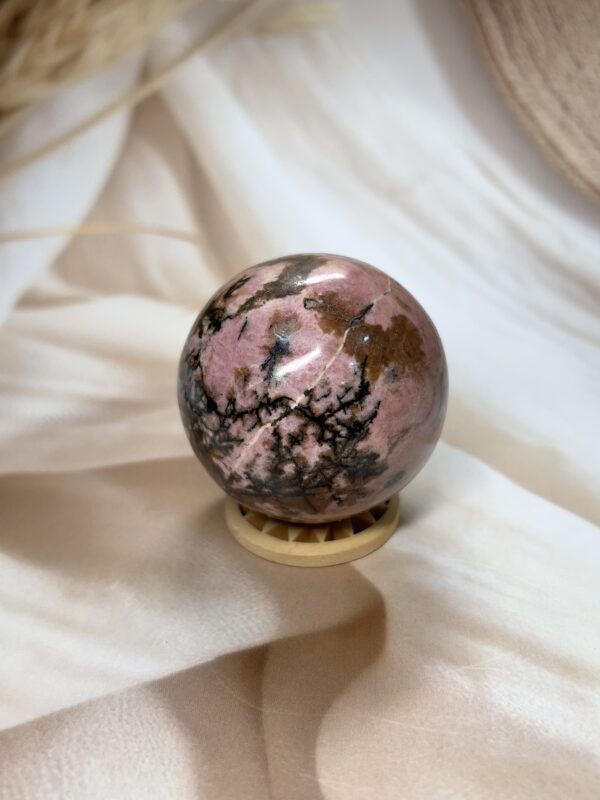
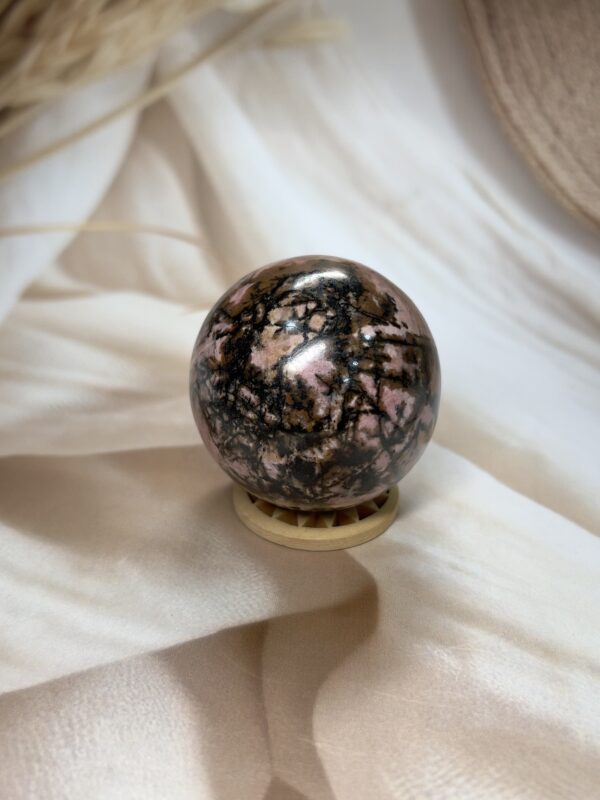



Natural Rhodonite Sphere • 222 GM • 5 CM Diameter
A Sphere of Compassion, Emotional Strength & Grounded Heart Energy
This Natural Rhodonite Sphere brings together three things that make a crystal particularly appealing:
A beautiful natural gemstone.
A meaningful energetic tradition.
A perfectly balanced sculptural form.
At approximately 5 CM in diameter and 222 GM, the sphere has a satisfying weight in the hand and enough presence to stand out beautifully as a display piece.
Rhodonite itself is known for its characteristic pink to rose-red colour, with natural material ranging from soft pink through deeper purplish or reddish pink. It is a manganese-rich pyroxenoid mineral with an ideal composition of MnSiO₃, although natural Rhodonite commonly contains substitutions of calcium, iron and magnesium.
The gemstone’s name comes from the Greek rhodon, meaning rose, referring directly to its beautiful pink colour. Rhodonite has been used for centuries as an ornamental stone and has been fashioned into cabochons, beads, carvings, spheres and other decorative objects.
The Natural Beauty of Rhodonite
Rhodonite is especially attractive because natural material does not necessarily have one perfectly uniform pink colour.
Depending on its formation, it can display:
- Soft blush pink
- Rose pink
- Raspberry or purplish pink
- Reddish-pink areas
- Grey or brown mineral zones
- Dark manganese-oxide markings
- Natural internal inclusions
- Subtle colour variation
GIA’s studies of Rhodonite show that even attractive gem material can contain associated minerals and colour variation, while classic Rhodonite is often recognisable by its pink body and darker manganese-oxide associations.
That means the beauty of Rhodonite comes from natural mineral character, not perfect uniformity.
Every sphere carries its own geological pattern.
What Is Rhodonite?
Rhodonite is a manganese-rich silicate mineral belonging to the pyroxenoid group. Its ideal chemical formula is MnSiO₃, although natural examples commonly contain substitutions of calcium, iron and magnesium. It crystallises in the triclinic crystal system.
It is found in manganese-rich geological environments and has important occurrences in places including Russia, Australia, Brazil, the United States, Peru, Sweden and Japan.
Rhodonite is relatively uncommon as a flawless gemstone because it has perfect cleavage in two directions and a relatively low hardness, generally around 5.5–6 on the Mohs scale for classic material. This is one reason it has traditionally remained particularly popular as a collector’s and ornamental stone.
Rhodonite’s Traditional Crystal Identity
In modern crystal traditions, Rhodonite is best known as a Heart-and-Root stone.
Unlike crystals whose symbolism focuses only on attracting love, Rhodonite is traditionally associated with something much more practical:
Healing emotional wounds while remaining grounded.
It is commonly chosen for intentions involving:
- Compassion
- Forgiveness
- Self-love
- Self-worth
- Emotional balance
- Relationship harmony
- Courage
- Grounding
- Resilience
- Emotional recovery
- Healthy boundaries
- Personal growth
Rhodonite’s traditional associations are particularly centred on processing difficult emotions without becoming overwhelmed by them.
These are traditional crystal-healing and spiritual associations, not scientifically proven effects.
Chakra Associations
Heart Chakra • Anahata
Love • Compassion • Forgiveness • Emotional balance
The Heart Chakra is the primary chakra traditionally associated with Rhodonite.
It is traditionally connected with:
- Love
- Compassion
- Acceptance
- Forgiveness
- Emotional connection
- Relationships
- Empathy
Rhodonite is commonly used in crystal practices where the intention is not simply to attract love, but to heal emotional hurt, rebuild trust, develop self-respect and create healthier emotional relationships.
Root Chakra • Muladhara
Grounding • Stability • Security • Strength
Rhodonite is also traditionally connected with the Root Chakra.
This association adds an important dimension to its Heart Chakra symbolism.
It represents:
Feeling deeply without losing your centre.
Caring without abandoning your boundaries.
Opening your heart while remaining grounded.
This Heart + Root combination is one of the clearest traditional identities of Rhodonite.
Traditional Metaphysical Benefits
Emotional Healing
Rhodonite is traditionally used for working through emotional hurt, disappointment, heartbreak and difficult relationship experiences. It is often described as a stone for emotional recovery rather than emotional avoidance.
Forgiveness
One of Rhodonite’s strongest traditional associations is forgiveness—toward other people and toward yourself.
Self-Love & Self-Worth
It is commonly chosen for rebuilding self-respect, confidence and a healthier relationship with yourself after emotionally difficult experiences.
Compassion
Rhodonite traditionally encourages compassion and empathy while maintaining personal grounding.
Relationship Harmony
Crystal practitioners often use Rhodonite for intentions involving understanding, reconciliation, communication and healthier relationships.
Emotional Balance
The Heart-and-Root combination is traditionally interpreted as helping emotional openness remain connected to stability.
Courage
Rhodonite is traditionally associated with the courage to face uncomfortable emotions rather than continually suppressing them.
Resilience
It is commonly regarded as a stone for recovering emotional strength and moving forward after setbacks.
Healthy Boundaries
Modern crystal traditions increasingly emphasise Rhodonite’s ability to combine compassion with self-respect and boundaries rather than people-pleasing.
Personal Growth
Rhodonite is traditionally used when the goal is to turn painful experiences into greater emotional maturity and self-awareness.
Traditional Physical & Body Associations
For customers who are interested in traditional crystal-healing correspondences, Rhodonite is associated with several areas of the physical body.
These are traditional lithotherapy associations rather than medically established effects.
Heart & Circulation
Rhodonite is traditionally associated with the heart and circulatory system, reflecting its strong Heart Chakra correspondence. Some crystal-healing traditions specifically list the heart and circulation among its physical associations.
Blood
Some traditional systems associate Rhodonite with blood and blood circulation, particularly because of its manganese-rich composition and red-pink colouring.
Lungs & Respiratory System
Rhodonite is also traditionally associated with the lungs and respiratory system.
Nervous System
Some crystal-healing traditions connect Rhodonite with the nervous system and nervous tension, particularly where emotional stress is involved.
Liver
Traditional lithotherapy sources specifically associate Rhodonite with the liver and the body’s cleansing processes.
Metabolism
Some traditional crystal-healing references associate Rhodonite with metabolism and physical energy.
Joints
Traditional sources also associate Rhodonite with the joints and physical recovery.
Important Health Note
There is no reliable scientific evidence that Rhodonite treats heart disease, improves circulation, changes blood chemistry, treats lung or nervous-system disorders, improves liver function, alters metabolism, or heals joint conditions.
These associations belong to traditional crystal-healing and lithotherapy systems and should be understood as spiritual or symbolic wellness correspondences, not medical benefits.
The Sphere Shape
The sphere adds a separate layer of meaning to the stone.
Because a sphere has no beginning or end, it has traditionally been associated with:
- Wholeness
- Unity
- Balance
- Harmony
- Continuity
- Completion
- Infinite movement
In crystal traditions, spherical stones are often regarded symbolically as having a more even, all-around energy, making them popular for meditation, room placement and energy-work practices.
With Rhodonite, that creates a particularly fitting combination:
The Sphere represents wholeness.
Rhodonite represents emotional healing and balance.
Together, the symbolism becomes:
A Whole Heart. A Grounded Mind. A Balanced Life.
Why Rhodonite Works So Well as a Sphere
Rhodonite’s colouring is naturally expressive.
A flat piece shows one surface.
A sphere gives you an opportunity to see the stone’s colour, inclusions and mineral pattern continuously around the form.
As the sphere rotates, different sections of the natural material come forward.
This makes it both:
A mineral specimen
and
A decorative object.
At approximately 5 CM, it is also large enough to appreciate the gemstone visually without becoming difficult to place.
Ways to Use Your Rhodonite Sphere
Heart-Centred Meditation
Place or hold the sphere while focusing on self-love, compassion, forgiveness or emotional balance.
Relationship Intention Work
Use it during journaling or reflection around communication, emotional healing and healthier relationships.
Home Display
Its rounded form works naturally on a shelf, console, bedside table or dedicated crystal display.
Workspace
A useful symbolic reminder of maintaining emotional balance, compassion and self-worth while dealing with everyday pressure.
Crystal Collection
Its sphere form, natural Rhodonite character and substantial 222 GM weight make it a beautiful addition to a collection of polished mineral specimens.
Where to Place Your Rhodonite Sphere
Bedroom
A fitting choice for a personal environment associated with self-love, emotional reflection and relationship harmony.
Meditation Space
Particularly appropriate for Heart Chakra practices, forgiveness work and emotional reflection.
Living Room
The sphere is visually balanced from every direction, making it an elegant display object in a main living space.
Workspace
Place it near your desk as a symbolic reminder to remain grounded and emotionally steady during demanding situations.
Physical Properties
Rhodonite is a triclinic manganese-rich silicate mineral with an ideal formula of MnSiO₃, although natural specimens commonly contain substitutions of Ca, Fe and Mg.
It generally has a hardness of around 5.5–6 on the Mohs scale and perfect cleavage in two directions, so it should be treated more carefully than harder stones such as Quartz.
Rhodonite is commonly found as massive translucent-to-opaque material, with attractive pink varieties particularly valued for ornamental and gem use.
Specifications
Product: Rhodonite Sphere
Stone: Natural Rhodonite
Approx. Weight: 222 GM
Approx. Diameter: 5 CM
Shape: Sphere
Colour: Natural Rose / Pink / Reddish-Pink
Finish: Polished
Type: Natural Crystal / Mineral Sphere
Care Guide
Rhodonite is comparatively soft and has perfect cleavage, so gentle care is important.
- Clean gently with a soft, slightly damp cloth.
- Avoid abrasive cloths and cleaning products.
- Keep away from harsh chemicals.
- Avoid dropping the sphere onto hard surfaces.
- Store separately from harder gemstones to prevent scratches.
- Handle carefully when placing or removing it from a stand.
- Do not use ultrasonic or steam cleaners.
- Keep it in a stable position so it cannot roll or fall.


Reviews
There are no reviews yet.