

Icy Blue Crystal Formations • One-of-One Collector Specimen • Peace & Higher Awareness
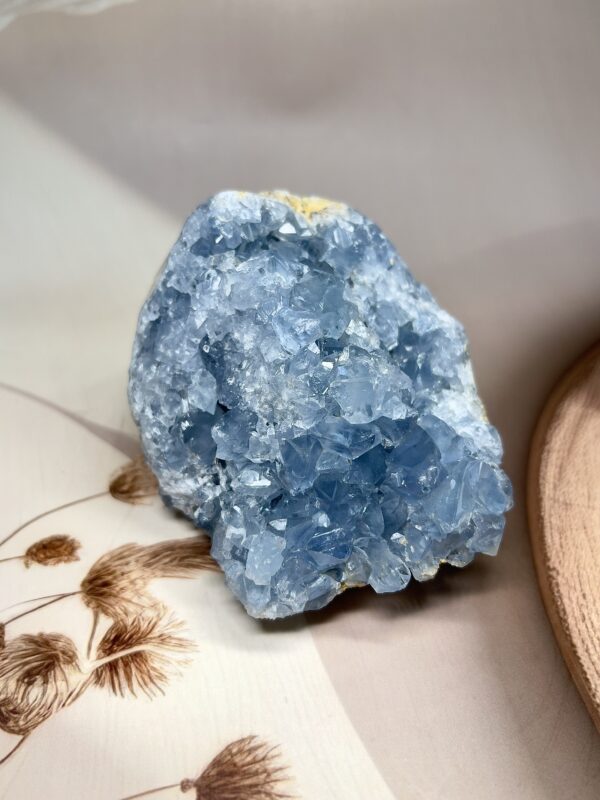
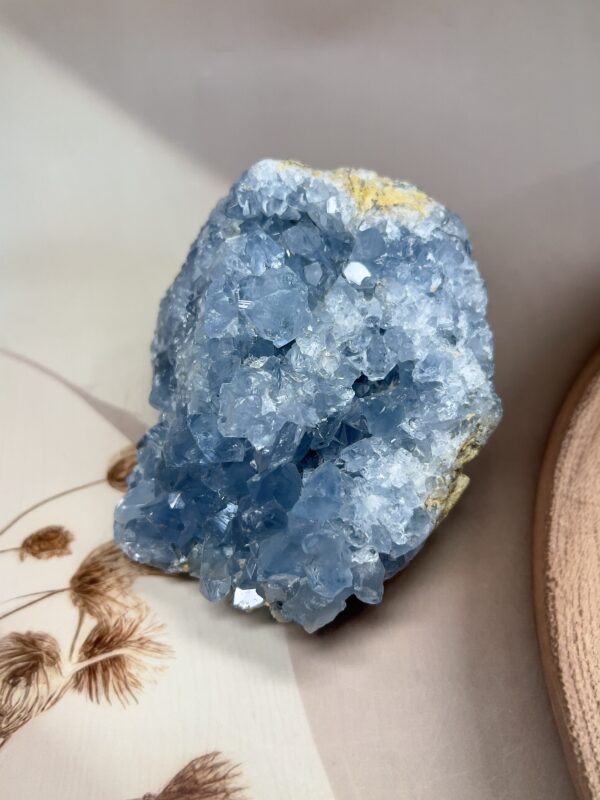
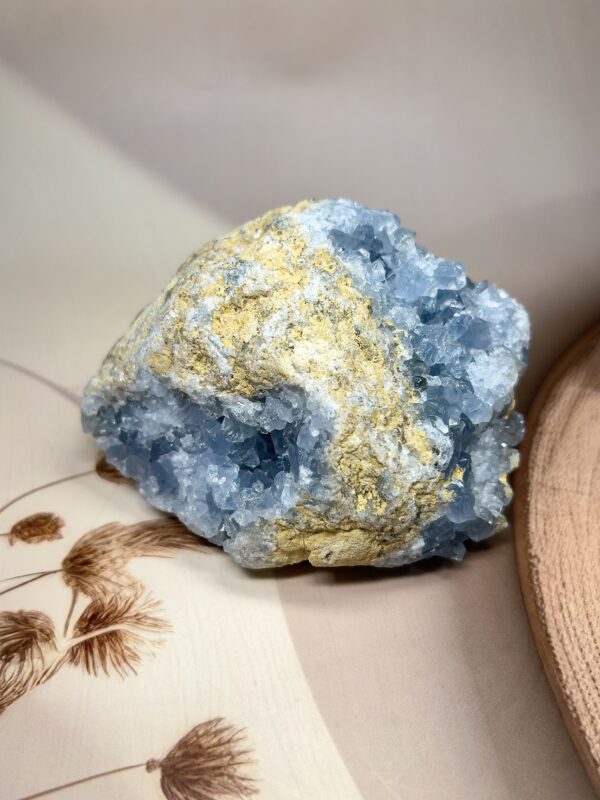
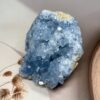
The Premium Blue Celestine Cluster is a spectacular natural mineral specimen with a remarkable concentration of delicate blue crystal formations across its surface.
Rather than presenting as a single smooth stone, this specimen is built from hundreds of naturally formed crystal points and intergrown formations, creating a highly textured surface that catches and reflects light from countless angles.
The overall appearance moves between:
Soft icy blue
Pale sky blue
Deeper blue pockets
Glassy translucent areas
with natural variations throughout the cluster.
At approximately 977 GM, this is a substantial specimen with genuine display presence.
Approximate dimensions:
12 CM in length × 7 CM in width × 11 CM in height
One specimen. One natural formation. One-of-one.
What Is Celestine?
Celestine, also widely known as Celestite, is a naturally occurring mineral composed of strontium sulfate (SrSO₄).
It belongs to the Baryte Group and forms in a variety of geological environments, frequently developing as clusters of delicate crystals within cavities and geode-like formations.
Its natural colour can range from colourless and white to soft blue, pale sky blue and deeper blue tones, with individual specimens often showing natural variations in transparency and colour.
Celestine is particularly admired by mineral collectors for its:
- Beautiful blue colour
- Glassy to pearly lustre
- Delicate crystal formations
- Natural cluster growth
- Geode-style formations
- Distinctive crystal texture
The blue colour combined with the intricate crystal growth makes Celestine one of the most recognisable blue collector minerals.
The Beauty of This Cluster
The defining feature of this specimen is the density of its crystal growth.
Instead of a handful of isolated crystals, the surface is covered with closely packed formations that overlap and interlock naturally.
This produces an almost sparkling, crystalline landscape.
The larger formations become easier to see toward the central and lower portions, while finer crystal growth creates a delicate texture across the surrounding areas.
The result is a cluster with considerable visual depth.
From a distance, it glows blue. Up close, an entire world of crystal formations appears.
Natural Blue Colour
Celestine is particularly famous for its blue colour.
Depending on the specimen, the colour can vary from:
Very pale blue
to
Icy blue
to
Sky blue
and occasionally
More saturated blue areas.
This specimen contains beautiful variation between lighter and deeper blue zones, giving the cluster more dimension than a completely uniform blue specimen.
Small natural differences in colour and transparency are part of the mineral’s individuality.
The Crystal Formations
One of the strongest reasons collectors appreciate Celestine is the way individual crystals grow together.
Rather than being artificially arranged, the crystals develop naturally in groups, producing:
- Interlocking formations
- Small crystal points
- Layered growth
- Open pockets
- Reflective crystal faces
- Uneven natural surfaces
- Dense areas of clustered growth
Each section of this specimen therefore has its own character.
Some areas are finer and more delicate.
Others are more densely crystalline.
Some catch the light intensely.
Others appear softly translucent.
The entire cluster is a record of how the mineral grew.
A Collector’s Specimen
At nearly 1 KG in weight, this specimen goes considerably beyond the scale of a tiny pocket crystal.
Its 12 × 7 × 11 CM proportions give it enough presence to anchor a display while remaining practical for a shelf, cabinet, side table or dedicated mineral collection.
This is a particularly fitting piece for collectors who appreciate:
Natural crystal growth
Blue mineral specimens
Geode-style clusters
Large display minerals
One-of-one formations
Unique geological character
The exact arrangement of its crystals cannot be duplicated.
The Throat Chakra
Throat Chakra — Vishuddha
Communication • Truth • Self-Expression • Listening
Celestine is most strongly associated with the Throat Chakra in modern crystal traditions.
The Throat Chakra is traditionally linked with:
- Communication
- Honest self-expression
- Listening
- Speaking one’s truth
- Clear communication
- Healthy boundaries
- Authenticity
Celestine is therefore commonly chosen when the intention is to communicate more calmly and clearly.
Its symbolism can be especially meaningful during situations where emotions are strong but the message still needs to be expressed thoughtfully.
Say what matters. Say it clearly. Say it with calm.
The Third Eye Chakra
Third Eye Chakra — Ajna
Intuition • Insight • Mental Clarity • Inner Awareness
Celestine is also traditionally associated with the Third Eye Chakra.
This energy centre is traditionally connected with:
- Intuition
- Perception
- Inner awareness
- Reflection
- Insight
- Recognising patterns
- Quiet mental clarity
- Trusting inner judgement
Within crystal practices, Celestine is often used during meditation or reflective practices where the goal is to quiet external distraction and pay closer attention to inner thoughts.
The Crown Chakra
Crown Chakra — Sahasrara
Spiritual Awareness • Wisdom • Meditation • Higher Perspective
The pale blue, almost heavenly appearance of Celestine also gives it a strong traditional connection with the Crown Chakra.
This association centres on:
- Spiritual awareness
- Meditation
- Wisdom
- Contemplation
- Expanded perspective
- Inner peace
- Spiritual connection
This is one reason Celestine is so often found in meditation and spiritual spaces.
The Upper-Chakra Connection
Celestine’s traditional chakra associations create a natural progression:
Throat → Speak Clearly
Third Eye → See Clearly
Crown → Understand Deeply
This makes it particularly meaningful for people working on communication, reflection, intuition and spiritual awareness at the same time.
Traditional Metaphysical Benefits
Peace & Calm
Celestine is one of the crystals most traditionally associated with peace, serenity and a quieter emotional atmosphere.
It is particularly popular for meditation and spaces intended for relaxation.
Mental Clarity
Its traditional Third Eye association makes it a popular choice when the mind feels crowded with too many thoughts.
Calm Communication
Celestine is traditionally used to encourage speaking without unnecessary anger, defensiveness or emotional escalation.
Better Listening
Its Throat Chakra symbolism extends beyond speaking. It is also associated with listening carefully and understanding what another person is actually communicating.
Intuition
Celestine is traditionally connected with trusting subtle inner impressions and developing greater awareness of personal instincts.
Emotional Reassurance
The stone is commonly used symbolically during emotionally demanding periods as a reminder to slow down rather than react immediately.
Spiritual Awareness
Celestine has a strong place in modern spiritual practices focused on meditation, contemplation and connection with higher awareness.
Meditation
Its peaceful traditional symbolism makes it particularly popular for meditation rooms, altars and quiet personal spaces.
Dream Work
Celestine is also traditionally associated with dreams, reflection and remembering insights that arise during sleep or meditation.
Patience
Its symbolism encourages allowing understanding to develop gradually rather than forcing immediate answers.
Perspective
Celestine is traditionally associated with stepping away from immediate emotional reactions and looking at a situation from a broader perspective.
Protection from Emotional Overwhelm
Some crystal traditions associate Celestine with maintaining emotional boundaries and creating distance from overwhelming external influences.
Gentle Spiritual Connection
Celestine is strongly associated in modern crystal traditions with angelic and celestial symbolism, making it popular among those whose spiritual practices involve prayer, guidance, contemplation or a sense of connection with something greater than themselves.
Celestine in Real-Life Situations
The traditional symbolism of Celestine can be applied in very practical ways.
For Difficult Conversations
Keep it nearby before or during a conversation where calm communication matters.
Its Throat Chakra symbolism can serve as a reminder to:
Listen first. Speak clearly. Avoid reacting unnecessarily.
For Overthinking
Place the cluster in a quiet area where it becomes a visual reminder to step away from repetitive thoughts and return to what actually needs attention.
For Stressful Workdays
A Celestine cluster on a desk can represent calm communication, patience and maintaining perspective during demanding situations.
For Meditation
Its traditional Third Eye and Crown associations make it particularly suited to meditation, breathwork, prayer and reflective practices.
For Bedtime Routines
Celestine is traditionally associated with peaceful rest and dream work, making a carefully placed cluster a popular addition to a calming nighttime environment.
Because Celestine is delicate, it should be kept safely on a stable surface rather than handled casually in bed.
For Journaling
Its traditional connection with self-reflection and inner awareness makes it a natural companion for journaling, especially when working through difficult emotions or important decisions.
For Spiritual Spaces
The celestial appearance and traditional spiritual associations make Celestine particularly beautiful in:
Prayer spaces
Meditation rooms
Altars
Quiet corners
Mindfulness spaces
Traditional Physical & Body Associations
In crystal-healing and lithotherapy traditions, Celestine is associated primarily with the upper body, head and respiratory areas.
These are traditional energetic correspondences and are not medically proven effects.
Throat & Voice
Celestine’s strongest physical correspondence is traditionally with the throat, voice and upper neck, reflecting its Throat Chakra association.
Traditional practices connect it symbolically with calm expression and communication.
Lungs & Respiratory System
Celestine is also traditionally associated with the lungs and respiratory system, particularly around gentle breathing and a sense of physical relaxation.
Nervous System
Crystal-healing traditions commonly connect Celestine with the nervous system, especially calmness, relaxation and reducing feelings of mental overload.
Brain & Mental Awareness
Its Third Eye and Crown associations create traditional links with the brain, mental awareness, concentration and inner perception.
Eyes
Some traditional systems associate Celestine with the eyes and visual perception, reflecting its broader Third Eye symbolism.
Ears & Hearing
Celestine is also traditionally linked with the ears and hearing, particularly in practices focused on listening and awareness.
Upper Chest
The stone’s connection with the Throat Chakra and respiratory system leads to traditional associations with the upper chest and collarbone region.
Sleep & Rest
Celestine is widely used in traditional crystal practices for bedtime intentions, relaxation and peaceful sleep.
Important Health Note
There is no reliable scientific evidence that wearing, carrying or displaying Celestine improves throat function, voice, lung function, nervous-system health, brain function, vision, hearing or sleep disorders.
These associations belong to traditional crystal-healing and lithotherapy practices only.
Celestine is best enjoyed as a natural mineral specimen, decorative piece, meditation companion and spiritual symbol, rather than as a substitute for medical treatment.
The Celestial Character of Celestine
The name Celestine comes from a word associated with the celestial or heavenly, an association inspired by the mineral’s characteristic pale blue colour.
That symbolism has continued into modern crystal culture.
Its soft blue appearance naturally evokes:
Open skies
Stillness
Peace
Quiet reflection
Higher awareness
This is part of what makes a Blue Celestine Cluster particularly beautiful in a meditation or spiritual space.
It looks like a fragment of sky transformed into crystal.
Why a Cluster Is Especially Beautiful for Celestine
Celestine’s natural beauty is particularly suited to the cluster form.
The individual crystals remain visible as a group, allowing the natural growth pattern to become part of the display.
A polished stone would conceal much of that geological story.
A cluster does the opposite.
It puts the crystal growth itself on display.
The many blue formations catch light individually, creating subtle sparkle across the surface.
The cluster is not merely shaped from the mineral—it displays how the mineral naturally grew.
A One-of-One Natural Formation
Every natural Celestine cluster develops according to its own geological conditions.
Crystal size, orientation, density, colour and internal structure can vary dramatically.
This specimen is a one-of-one piece within the collection, with an arrangement of crystal formations that cannot be reproduced exactly.
The result is a display piece with its own natural identity rather than a mass-produced decorative object.
Perfect For
This Premium Blue Celestine Cluster is particularly suited to:
- Mineral collections
- Home décor
- Meditation spaces
- Prayer spaces
- Spiritual altars
- Bedside displays
- Office desks
- Quiet reading areas
- Mindfulness spaces
- Crystal collections
- Meaningful gifting
- Collector displays
Its pale blue colour works especially beautifully with:
White
Natural wood
Warm neutrals
Soft grey
Minimalist interiors
and
Meditation spaces
Specifications
Product: Premium Blue Celestine Cluster
Mineral: Natural Celestine / Celestite
Approx. Weight: 977 GM
Approx. Length: 12 CM
Approx. Width: 7 CM
Approx. Height: 11 CM
Colour: Natural Pale Blue to Blue
Form: Natural Crystal Cluster
Crystal Growth: Naturally Intergrown Crystal Formations
Lustre: Glassy to Pearly
Primary Traditional Chakras: Throat • Third Eye • Crown
Style: Premium Collector Specimen • One-of-One • Natural Display Piece
Care Guide
Celestine is a soft and brittle mineral with a Mohs hardness of approximately 3–3.5 and perfect cleavage, making it considerably more delicate than Quartz, Amethyst or many other commonly collected crystals.
The delicate crystal points can scratch, chip or break if handled roughly.
Its blue colour should also be protected from prolonged direct sunlight.
- Handle the cluster very carefully, preferably by supporting the solid base or underside.
- Never lift or carry it by individual crystal points.
- Place it on a stable, padded or secure surface.
- Avoid dropping or knocking the specimen.
- Keep away from direct sunlight for prolonged periods, as the blue colour can fade.
- Keep away from strong heat.
- Do not soak or submerge in water.
- Avoid saltwater, acids, vinegar and harsh chemicals.
- Do not use ultrasonic or steam cleaners.
- Dust gently using a very soft, dry brush or air blower.
- Keep away from rough fabrics and abrasive surfaces.
- Store separately from harder minerals that could scratch the crystal surfaces.

Reviews
There are no reviews yet.