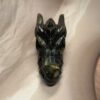
Dark, Powerful & Extraordinary Under Light
This is an exceptionally beautiful Labradorite carving.
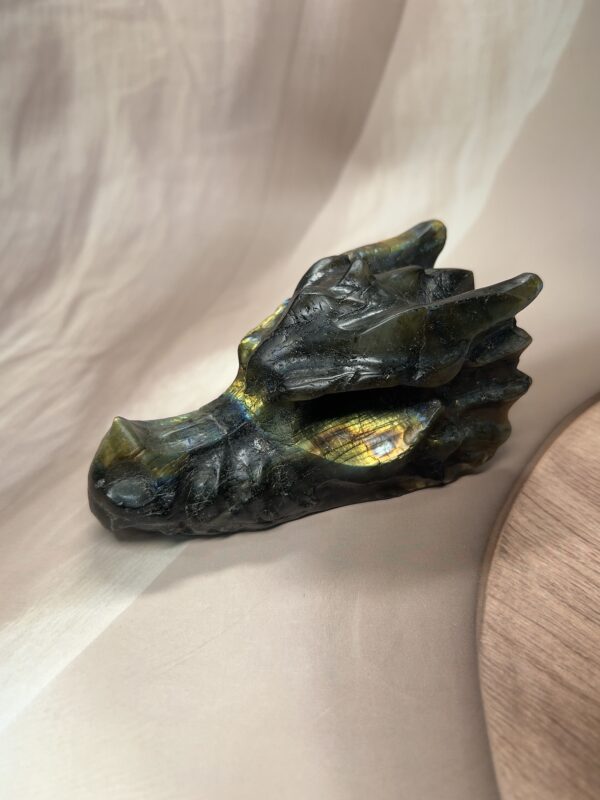
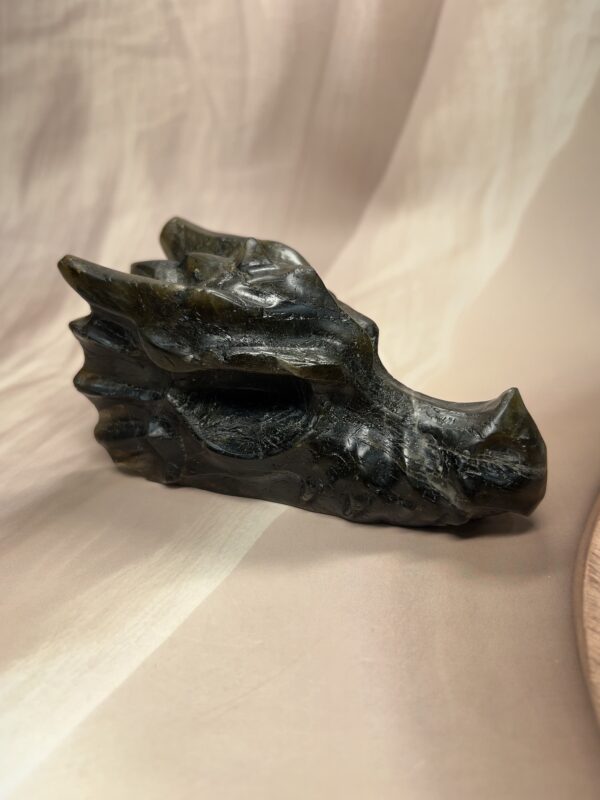
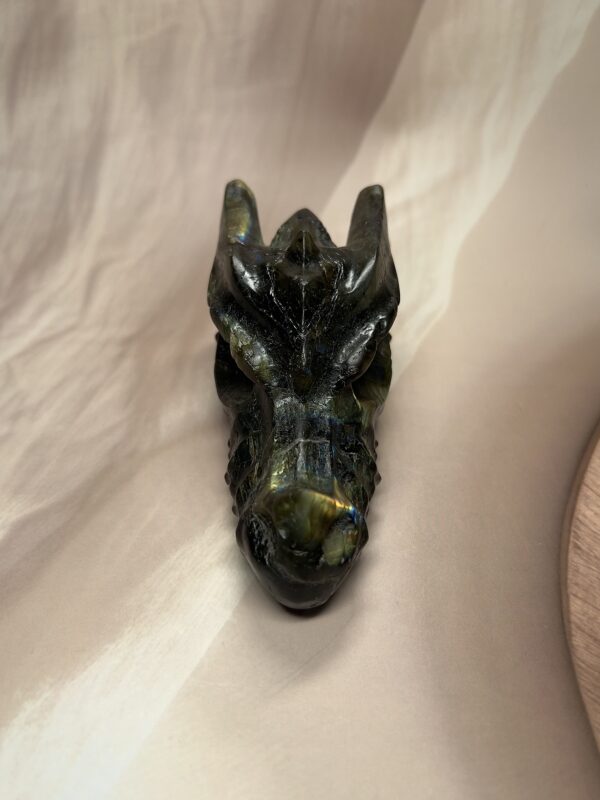
At first glance, the dragon appears almost entirely deep charcoal, smoky grey and black, with a smooth polished surface that gives the carving a strong, sculptural presence.
Then the light reaches the right area.
And the dragon changes completely.
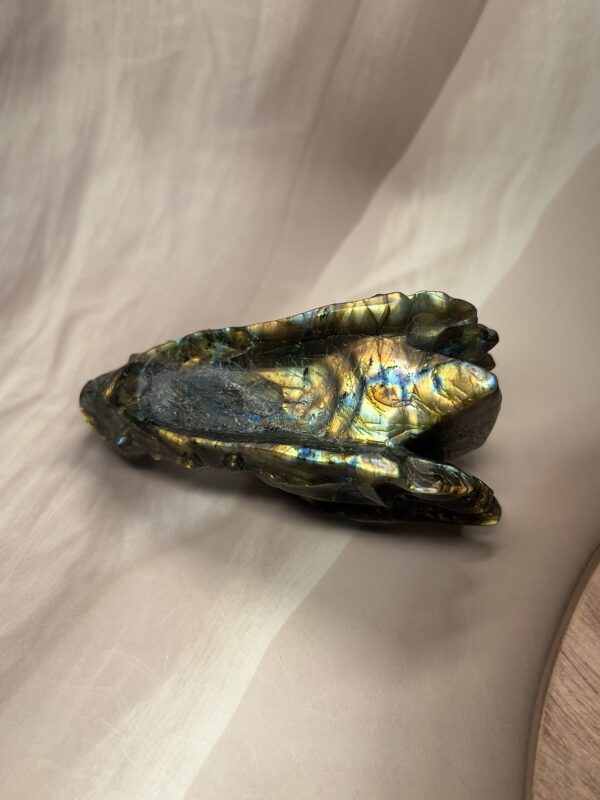
Across the body, sides, head and projecting forms, vivid patches of golden-yellow, green and electric blue flash appear within the dark stone. Some areas reveal a bright metallic gold glow, while other angles bring out intense blue and blue-green.
That phenomenon is known as labradorescence, and it is the defining optical feature of gem-quality Labradorite. GIA explains that the effect is produced by light interacting with extremely thin internal feldspar layers, creating broad flashes of colour that change with the viewing angle.
This particular carving makes excellent use of that phenomenon because its curved, sculpted surfaces continually change orientation relative to the light.
The dragon doesn’t have one appearance.
It has several.
Move it.
Turn it.
Change the light.
The flash reveals itself.
The Labradorite in This Piece
Labradorite is a plagioclase feldspar whose composition falls within the albite–anorthite series. Mindat gives the formula approximately as (Ca,Na)[Al(Al,Si)Si₂O₈], with an albite-to-anorthite ratio characteristic of Labradorite. It has a hardness of approximately 6–6.5 on the Mohs scale and perfect cleavage.
Its natural body colour can range from grey, dark grey, blue-grey and greenish tones, with iridescent colour appearing across particular internal orientations.
This particular carving is visually dominated by a dark smoky body, which makes the bright labradorescent areas stand out dramatically.
The Gold & Blue Flash
This is the feature that deserves the most attention.
The photographs clearly show strong golden-yellow and blue flashes, particularly across the side and lower portions of the dragon.
Labradorite’s colour play is caused by interference and diffraction of light within microscopic alternating feldspar layers. The thickness and arrangement of those layers determine which wavelengths are reflected most strongly.
GIA’s research describes the relationship between the thickness of these internal lamellae and the resulting colours: different layer dimensions can produce blue, green, yellow, orange and other portions of the visible spectrum.
That explains exactly what makes this dragon so captivating.
The dark areas provide the background.
The internal feldspar structure provides the colour.
The movement provides the spectacle.
A Dragon Sculpted to Reveal the Stone
The carving is particularly effective because the Labradorite isn’t hidden beneath a flat surface.
The dragon has:
- A defined head
- Raised horns
- A long sculpted body
- Layered back and side details
- Projecting limbs/features
- A flowing, serpentine profile
- Multiple curved surfaces capable of catching light differently
That is important for a phenomenal stone.
A flat dark slab might reveal its flash from one preferred orientation.
A three-dimensional carving provides many different viewing angles.
As a result, different portions of the dragon can light up as it is moved.
The carving and the mineral phenomenon work together.
Why This Labradorite Is Especially Beautiful
The flash isn’t restricted to one tiny spot.
The photographs show multiple labradorescent zones distributed through the carving, with particularly impressive gold and blue areas.
This gives the dragon a remarkable contrast:
Dark body → luminous gold → electric blue → dark body again.
The result is almost reminiscent of light trapped beneath a dark surface.
And that visual contrast is exactly why high-quality Labradorite has such a strong collector following.
GIA describes labradorescence as one of the defining phenomenal effects of Labradorite, with flashes that can include blue, green, gold, orange and violet.
The Dragon Symbolism
The dragon is one of the most enduring symbolic creatures in Asian art.
In Chinese traditions, the dragon has historically been associated with protection, happiness, fertility, power, imperial authority and auspiciousness. The Metropolitan Museum of Art also notes its associations with water and the east.
The dragon is additionally regarded as one of the particularly auspicious creatures of the Chinese zodiac, associated with ambition, courage and opportunity.
For this carving, the dragon can therefore represent:
Strength
Protection
Courage
Wisdom
Power
Guardianship
Ambition
Opportunity
Good fortune
The design gives the Labradorite a very different character from an ordinary freeform.
It becomes a guardian figure.
Labradorite — Traditional Crystal Associations
In modern crystal-healing traditions, Labradorite is particularly associated with transformation, intuition, protection, self-discovery and inner awareness.
It is often described as a stone for periods when life is changing and the individual is trying to remain grounded while developing a new perspective.
Traditionally associated with:
- Intuition
- Transformation
- Protection
- Self-discovery
- Mental clarity
- Inner awareness
- Creativity
- Emotional steadiness
- Resilience
- Spiritual exploration
- New perspectives
Its dark body and unexpected flashes also lend themselves naturally to the traditional symbolism of discovering what is hidden beneath the surface.
These are traditional metaphysical associations and are not scientifically proven effects.
Chakra Associations
Third Eye Chakra — Ajna
Intuition • Insight • Perception • Inner awareness
The Third Eye is Labradorite’s strongest traditional chakra association.
It is associated with the area between the eyebrows and is traditionally connected with intuition, discernment, imagination, inner vision and deeper understanding.
Labradorite is therefore frequently used during meditation and reflective practices.
Throat Chakra — Vishuddha
Communication • Expression • Truth
Some crystal-healing systems also associate Labradorite with the Throat Chakra, particularly around expressing insights clearly and communicating authentically.
This creates a useful symbolic progression:
Third Eye → Understand
Throat → Express
Traditional Metaphysical Benefits
Intuition
Labradorite is traditionally used to strengthen awareness of one’s instincts and subtle internal signals.
Transformation
Its most distinctive metaphysical association is navigating major changes without losing your centre.
Protection
Labradorite is traditionally used as a protective stone, especially for maintaining energetic boundaries while engaging in emotional or spiritual work.
Mental Clarity
It is commonly used symbolically to reduce mental clutter and approach situations with greater discernment.
Self-Discovery
Traditional Labradorite practice focuses on uncovering patterns, fears, beliefs and strengths that may not have been immediately visible.
Creativity
Labradorite is associated with imagination, unconventional thinking and exploring new ideas.
Emotional Stability
Some modern traditions use Labradorite to maintain a calmer emotional centre while moving through uncertainty or change.
Resilience
Its transformation symbolism makes it a traditional choice for periods where resilience and adaptation are important.
Traditional Physical & Body Associations
For customers interested in crystal-healing traditions, Labradorite has several commonly cited physical correspondences. These are traditional lithotherapy associations and are not medically established effects.
Eyes & Vision
Traditional crystal-healing systems associate Labradorite with the eyes and vision, particularly because of its Third Eye correspondence.
Brain & Mental Function
It is traditionally associated with the brain and mental clarity, reflecting its use in practices focused on concentration, thought organisation and awareness.
Nervous System
Some lithotherapy traditions associate Labradorite with nervous-system balance and recovery from mental or emotional overload.
Respiratory System
Some traditional systems associate Labradorite with the lungs, breathing and respiratory system, particularly where stress and tension are involved.
Metabolism & Digestion
Traditional crystal-healing sources also associate Labradorite with digestion and metabolic processes.
Hormonal / Endocrine System
Some traditions connect Labradorite with hormonal balance and the endocrine system, particularly during periods of change and transition.
Adrenal / Stress Response
Lithotherapy sources sometimes associate Labradorite with the adrenal glands and the body’s response to stress.
Important Health Note
There is no reliable scientific evidence that Labradorite treats eye conditions, brain disorders, respiratory disease, digestive or metabolic disorders, hormonal problems, adrenal disorders, or nervous-system conditions. These associations belong to traditional crystal-healing systems and should not be interpreted as medical treatment.
For a product listing, they are best presented as traditional energetic correspondences, while actual medical concerns should be handled by qualified healthcare professionals.
The Dragon + Labradorite Combination
This is where the piece becomes particularly compelling.
Labradorite
Intuition • Transformation • Protection • Inner awareness
Dragon
Strength • Courage • Protection • Power • Good Fortune
Together:
Intuition With Strength.
Transformation With Protection.
Awareness With Courage.
The dragon gives physical form to the protective symbolism.
Labradorite gives the piece its mysterious, changing light.
The result is particularly suitable for someone who wants a symbolic guardian sculpture rather than simply a mineral specimen.
Why It Works as a Statement Piece
At approximately 11.4 CM long and 6.26 CM high, this is not an insignificant carving.
It has a compact footprint but considerable sculptural density.
The dragon’s raised features create strong shadows across the dark Labradorite, while the labradorescent areas illuminate individual sections of the carving.
This makes it particularly impressive under directional lighting.
Under softer lighting, it can appear almost entirely dark.
Under the right angle:
gold flashes across the body.
blue appears along an edge.
green emerges from another surface.
And suddenly the dragon looks completely different.
Where to Display Your Labradorite Dragon
Entrance / Foyer
The dragon’s traditional guardian symbolism makes an entrance an especially meaningful placement. In Chinese visual traditions, dragon imagery has long carried protective and auspicious associations.
Workspace
Labradorite’s traditional associations with intuition, mental clarity, transformation and creativity make a desk, office or studio an appropriate setting.
Meditation Space
Place it where you meditate, journal or practise reflection for a symbolic focus on intuition, transformation and inner awareness.
Living Room
Its dragon form gives it immediate decorative presence, while the dark body and brilliant flashes make it especially effective on a shelf, console or display cabinet.
Crystal Collection
At 350 GM, this is substantial enough to sit comfortably within a serious collection of mineral carvings and statement specimens.
Physical Properties of Labradorite
Labradorite is a plagioclase feldspar with a hardness of approximately 6–6.5 Mohs. It has perfect cleavage, which means it can split if struck in the appropriate direction.
Its labradorescence results from microscopic internal lamellae created through feldspar exsolution. The interaction of light with these layers produces the shifting blue, green, gold and other colours characteristic of phenomenal Labradorite.
The stone typically has a sub-vitreous to vitreous appearance, depending on the surface and material, and its dark body colour provides excellent contrast for the optical effect.
Specifications
Product: Labradorite Dragon Statement Piece
Stone: Natural Labradorite
Approx. Dimensions: 11.4 × 5.35 × 6.26 CM
Approx. Weight: 350 GM
Form: Dragon Carving
Body Colour: Deep Grey / Charcoal / Black
Natural Optical Effect: Labradorescence
Flash Colours Visible in This Piece: Gold / Yellow / Blue / Green
Finish: Sculpturally Carved & Polished
Type: Crystal / Mineral Collector’s Statement Piece
Care & Handling
Because Labradorite has perfect cleavage despite its moderate hardness, a good-quality carving can still be damaged by a sharp impact.
- Place on a stable, level surface.
- Support the main body when moving the carving.
- Never lift it by the horns, head, tail, limbs or other projecting features.
- Avoid dropping or striking the carving against hard surfaces.
- Avoid placing it near the edge of a shelf.
- Dust gently with a soft microfiber cloth or soft brush.
- Avoid abrasive materials and harsh chemicals.
- Do not use ultrasonic or steam cleaners.
- Store separately from significantly harder minerals to reduce scratching.
Reviews
There are no reviews yet.