

Kuber Stone — Ancient Wisdom, Stability & Prosperity
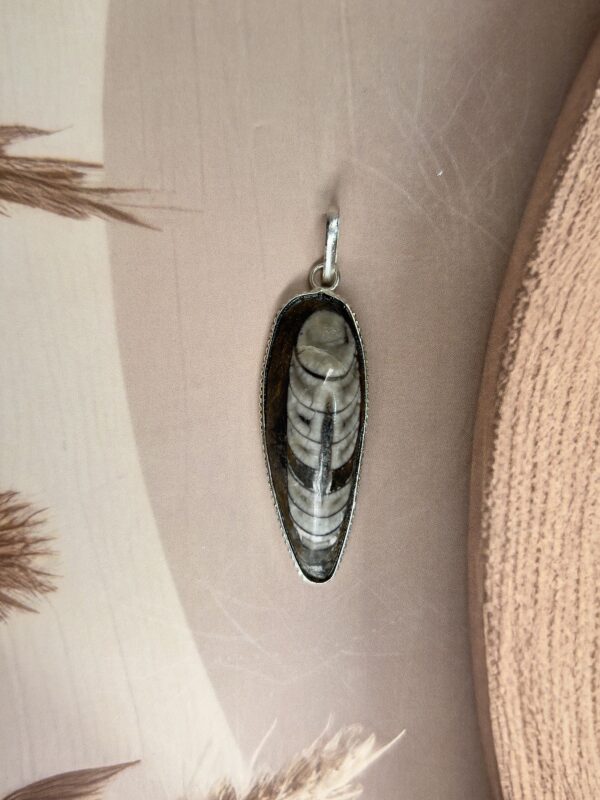
Discover the extraordinary natural history behind this Kuber Stone Orthoceras Fossil Pendant. The elongated fossil displays a series of pale, curved chambers separated by distinct dark lines, creating a striking segmented pattern against the darker surrounding matrix. Its tapered, leaf-like outline and polished surface bring out the fossil’s internal structure, while the understated German Silver setting keeps the focus on its ancient details.
What Is an Orthoceras Fossil?
Orthoceras is a scientific genus of extinct, straight-shelled marine cephalopods belonging to the nautiloid group. These animals were relatives of today’s nautiluses and lived in ancient seas hundreds of millions of years ago.
The name Orthoceras is also commonly used in the fossil trade for similar straight-shelled nautiloid fossils. Many polished specimens sold under this name, particularly those from Morocco, may not be identifiable to the exact genus from their finished appearance alone.
The distinctive structures visible in this pendant tell the story of the animal’s shell:
- Chambered shell: The shell was divided into a series of internal chambers as the animal grew.
- Septal divisions: These walls separated successive chambers, producing the characteristic segmented appearance.
- Siphuncle: In these ancient cephalopods, a tube-like structure connected the chambers and helped regulate fluid and gas, contributing to buoyancy control.
- Fossilisation: Over geological time, the original shell and surrounding material were preserved and mineralised, allowing parts of this ancient structure to survive.
The polished fossil reveals a small part of a marine world that existed long before humans. This makes the pendant more than a decorative accessory: it is a wearable connection to prehistoric life and the history of our planet.
Traditional Metaphysical Properties & Benefits
The name Kuber Stone is used commercially and in contemporary spiritual practices for Orthoceras fossils associated with prosperity, stability and grounded growth. These associations are symbolic beliefs rather than scientifically established effects.
1. Prosperity & Abundance
Kuber is the Hindu deity traditionally associated with wealth and prosperity. The commercial name Kuber Stone draws on this symbolism, and Orthoceras fossils are used in some modern spiritual and Vastu-inspired settings as reminders of financial stability and purposeful growth.
This symbolism may be meaningful when you want to:
- Work towards financial goals: Establish realistic objectives for saving, spending or building a business.
- Develop a prosperity mindset: Recognise opportunities while remaining practical about risks.
- Build long-term stability: Prioritise consistent progress over impulsive decisions.
- Stay focused on business ambitions: Keep your attention on the actions that contribute to sustainable growth.
- Practise financial responsibility: Make informed decisions instead of relying on luck alone.
The fossil can serve as a symbolic reminder of your intentions, but it does not attract money or guarantee wealth, business success or financial returns.
2. Grounding & Stability
Fossils are often associated in contemporary spiritual practices with grounding because they represent enduring natural structures and the passage of immense periods of time. Orthoceras is particularly suited to this symbolism because of its preserved form and connection to ancient marine environments.
It may be meaningful when you want to:
- Stay focused on the present: Concentrate on what needs your attention today.
- Establish consistent routines: Build habits that support your personal and professional responsibilities.
- Approach uncertainty practically: Focus on achievable steps rather than becoming overwhelmed by the unknown.
- Create a stable foundation: Give your long-term goals a realistic structure.
- Maintain perspective: Remember that lasting progress often takes patience.
Its grounding symbolism makes the pendant a thoughtful choice for a workspace, personal collection or everyday jewellery.
3. Endurance & Perseverance
Orthoceras fossils preserve evidence of life from an ancient marine world. In modern metaphysical interpretations, this long geological history is associated with endurance, adaptability and persistence.
It may serve as a reminder to:
- Continue working towards long-term goals: Remain consistent even when results take time.
- Adapt when circumstances change: Reconsider your approach instead of abandoning your direction at the first obstacle.
- Learn from experience: Use setbacks to make more informed decisions.
- Build dependable habits: Focus on actions you can repeat consistently.
- Remain patient: Recognise that meaningful progress is rarely achieved all at once.
This symbolism is particularly relevant to entrepreneurs, students, professionals and anyone working towards a demanding personal ambition.
4. Wise Decisions & Practical Thinking
The Kuber Stone association is also used symbolically for focus, stability and thoughtful decision-making. Its connection to prosperity is most meaningful when paired with preparation and sound judgement.
It may be meaningful when you want to:
- Evaluate opportunities carefully: Consider potential benefits and risks before committing.
- Avoid impulsive choices: Give yourself time to review important decisions.
- Prioritise what matters: Direct your time and resources towards realistic goals.
- Think beyond immediate rewards: Consider the longer-term consequences of your actions.
- Build confidence through preparation: Make decisions based on information rather than pressure.
The fossil represents an intention to act with patience and perspective rather than expecting immediate results.
5. Transformation & Learning Through Experience
Orthoceras fossils preserve traces of organisms that lived in environments very different from today’s world. In contemporary spiritual symbolism, fossils are sometimes associated with transformation, continuity and the lessons gained through experience.
This association may resonate with you when you are:
- Beginning a new chapter in life or business.
- Reviewing past decisions and identifying what you would do differently.
- Adapting to new responsibilities.
- Developing a more mature approach to challenges.
- Appreciating the ways experience shapes your direction.
Its symbolism encourages you to carry useful lessons forward while remaining open to change.
Chakra Associations
Root Chakra (Muladhara) — Primary Association
In contemporary crystal and fossil practices, Orthoceras fossils are commonly associated with the Root Chakra, traditionally linked to grounding, stability, security and connection to the physical world.
This association is particularly relevant to intentions involving:
- Stability: Establishing dependable personal and professional routines.
- Security: Working towards greater practical and financial independence.
- Grounding: Maintaining attention on the present and your immediate responsibilities.
- Endurance: Staying committed to worthwhile long-term goals.
- Connection to the Earth: Appreciating the natural processes that have shaped the planet over geological time.
The Root Chakra is traditionally associated with the base of the spine. Orthoceras’s earthy matrix and ancient geological history complement its symbolic themes of stability and grounding.
Solar Plexus Chakra (Manipura) — Ambition & Purposeful Action
Some modern spiritual interpretations also associate Kuber Stone with the Solar Plexus Chakra, which symbolises personal power, willpower, confidence and purposeful action.
This association may be meaningful when you want to:
- Take responsibility for your financial and professional decisions.
- Develop the discipline to pursue your ambitions.
- Build confidence in your capabilities.
- Turn plans into practical actions.
- Maintain direction when progress is gradual.
Together, these associations symbolise creating a stable foundation and developing the determination to build upon it.
Traditional Physical & Organ Associations
Unlike many crystals that have developed specific organ correspondences within modern crystal-healing traditions, Orthoceras fossils do not have a widely established, consistent set of organ-specific associations.
Their contemporary metaphysical symbolism centres more on grounding, endurance, stability and prosperity than on particular bodily systems.
General Vitality: Some modern spiritual interpretations connect fossils with resilience and enduring strength. This is symbolic; wearing an Orthoceras fossil has not been shown to improve physical stamina or energy levels.
Grounding & Emotional Perspective: The fossil may be used as a visual reminder to pause, reflect and approach responsibilities thoughtfully. It has not been shown to regulate the nervous system or treat stress-related conditions.
Organ Health: There is no reliable evidence that wearing an Orthoceras fossil benefits the heart, kidneys, liver, digestive system or any other organ.
The pendant is intended for personal adornment, fossil appreciation and symbolic spiritual use. It is not a medical treatment or substitute for professional healthcare.
Mohs Hardness & Durability
Approximate Hardness: 3–4 out of 10 for common calcite and limestone components
Unlike a single-mineral crystal, a polished Orthoceras fossil pendant can contain several materials, including preserved shell structures, mineral replacement and surrounding rock matrix. Its exact hardness therefore depends on its composition and fossilisation process.
Calcite, a common mineral in fossilised shells and limestone, has a Mohs hardness of approximately 3. Limestone typically falls around 3–4, although the hardness of a finished fossil specimen can vary.
This makes the pendant more delicate than quartz or Labradorite and means that its polished surface and fossil details require careful handling.
- Avoid scratches: Keep the pendant away from harder crystals, metal accessories and abrasive surfaces.
- Prevent impacts: Protect the fossil from drops and knocks that could chip the fossil or its surrounding matrix.
- Keep away from acids: Avoid vinegar, acidic cleaners and other acidic substances that may react with carbonate-rich material.
- Limit water exposure: Keep it dry and avoid soaking it.
- Clean gently: Use a soft, dry cloth rather than abrasive products.
- Protect the setting: Avoid applying pressure to the fossil or pulling forcefully on its metal loop.
The fossil’s delicate material and preserved details are part of its character, so gentle handling will help maintain its appearance.
Design & Styling
The elongated, pointed silhouette follows the natural shape of the fossil, while the pale segmented shell stands out against its dark brown and charcoal matrix. The slim German Silver setting provides a clean metallic outline that allows the fossil’s structure to remain the focal point.
- Minimalist styling: Pair it with a simple black, white or neutral outfit to highlight the fossil’s contrasting pattern.
- Earthy palettes: Complement its dark matrix with brown, beige, olive or charcoal tones.
- Casual wear: Style it with a plain shirt or top for a distinctive natural-history accent.
- Layered jewellery: Pair it with a simple chain, ensuring other pieces do not rub against the fossil surface.
- For collectors: Wear it as a conversation piece that combines jewellery with an appreciation for prehistoric marine life.
Choose this pendant for its ancient natural history, striking segmented structure and contemporary association with grounded ambition and prosperity.
Product Specifications
| Feature | Details |
|---|---|
| Product | Kuber Stone Pendant |
| Fossil | Orthoceras / straight-shelled nautiloid fossil |
| Material | Fossilised shell and surrounding rock matrix |
| Colours | Ivory, grey, dark brown and charcoal |
| Finish | Polished fossil specimen |
| Shape | Elongated, tapered form |
| Setting | German Silver |
| Primary Chakra Association | Root Chakra |
| Secondary Chakra Association | Solar Plexus Chakra |
| Approximate Hardness | Around 3–4/10 for common calcite/limestone components; varies by composition |
Care Instructions
- Keep dry: Avoid soaking, bathing or swimming while wearing the pendant.
- Avoid acids and harsh chemicals: Do not expose it to vinegar, acidic cleaners, perfumes or abrasive jewellery products.
- Clean gently: Wipe with a soft, dry cloth.
- Store separately: Keep it in a soft pouch or lined jewellery box, away from harder crystals and metal accessories.
- Protect against impacts: Avoid dropping the pendant, knocking it against hard surfaces or applying pressure to the fossil.
- Avoid aggressive cleaning: Do not use ultrasonic cleaners, steam cleaners or abrasive polishing materials.
- Check metal sensitivity: German Silver commonly contains nickel, which may trigger reactions in people with nickel allergies.


Reviews
There are no reviews yet.