
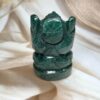
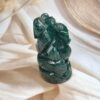
Genuine Nephrite Jade • 240 GM • Natural Fibrous Structure
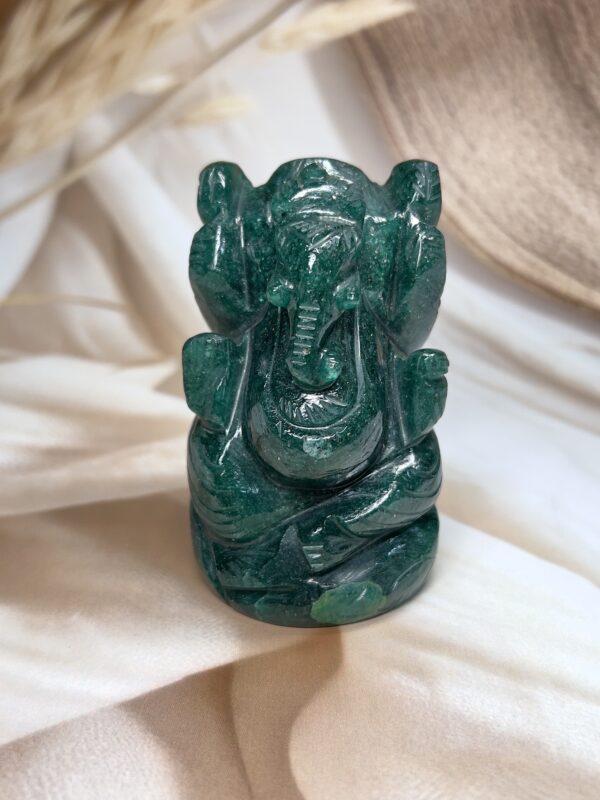
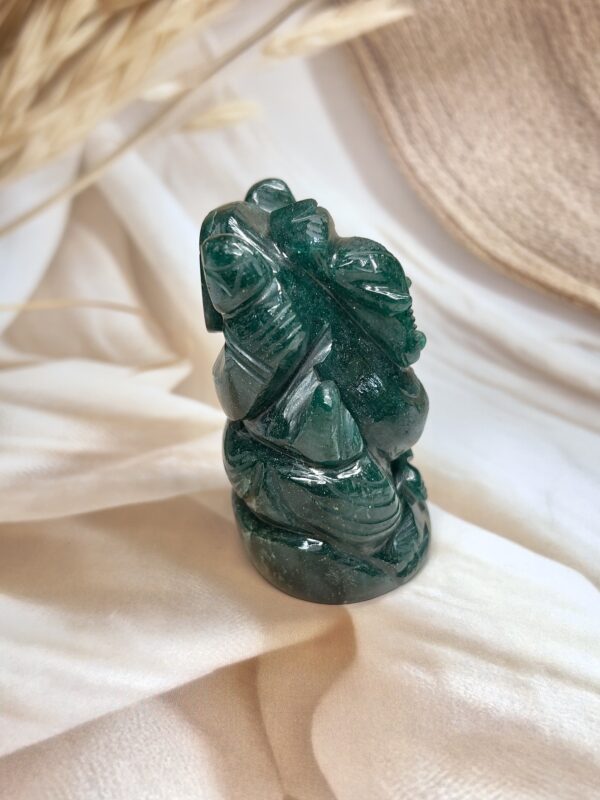
This is a particularly beautiful Ganesh Ji carving, made from genuine Green Nephrite Jade with a wonderfully rich green body and a naturally intricate internal structure.
At approximately 240 GM, with dimensions of 4.88 × 4.55 × 7.76 CM, the carving has a substantial presence while retaining the compact proportions that make gemstone deity carvings so easy to display in a personal sacred space, collection, office or home.
What makes this piece especially significant is the Nephrite itself.
The internal texture visible through the stone is not simply a surface pattern. Genuine Nephrite is characterised by an extremely dense, interlocking mass of microscopic amphibole fibres, producing the material’s distinctive toughness and characteristic fibrous appearance. GIA describes nephrite as a felt-like aggregate of densely packed amphibole fibres and notes that this structure gives it exceptional toughness and makes it particularly suitable for detailed carving.
This is real jade in the gemological sense — specifically Nephrite Jade.
What Is Nephrite Jade?
“Jade” refers to two distinct gem materials: Nephrite and Jadeite. Nephrite is primarily composed of amphibole minerals in the tremolite–actinolite series, while Jadeite belongs to a completely different mineral group.
Nephrite’s most distinctive physical characteristic is its densely interwoven fibrous structure.
Instead of being made up of large individual crystals that are easily separated, countless microscopic fibres interlock throughout the material. This gives Nephrite its exceptionally high toughness and makes it one of the classic materials used for intricate carving.
The green colour of Nephrite can vary considerably depending on its composition, particularly the amount of iron replacing magnesium within the tremolite–actinolite structure.
The Fibrous Structure You Can See
One of the most compelling qualities of this Ganesh Ji is the internal texture visible when light is directed through the stone.
Nephrite’s tightly packed amphibole fibres create a characteristic felted or fibrous internal structure. This structure is one of the important reasons Nephrite has such an exceptional reputation for toughness.
So when light reveals subtle internal texture within this carving, you are seeing a feature connected to the actual structure of the jade.
The texture is part of the stone itself.
It is not necessary for Nephrite to be perfectly transparent or completely uniform to be genuine. Natural jade commonly contains variations in tone, translucency, grain, texture and internal mineral structure.
The Beauty of This Green Nephrite
This carving has a particularly attractive green body colour, giving Ganesh Ji a rich natural appearance without overpowering the sculptural details.
Depending on the lighting, the stone can reveal different degrees of:
- Deep green
- Medium green
- Slightly lighter green areas
- Subtle tonal variation
- Translucent zones
- Fine internal fibrous texture
That variation is part of natural Nephrite.
High-quality jade has long been appreciated not just for colour but also for its texture, translucency, lustre and durability. The Metropolitan Museum notes that nephrite was especially valued in Chinese decorative arts for these physical qualities.
Why Ganesh Ji Is Such a Meaningful Form
Ganesha is one of the most widely revered Hindu deities and is traditionally associated with removing obstacles, wisdom, success and abundance. The Metropolitan Museum specifically describes Ganesha as being venerated throughout India and associated with success and abundance through the removal of obstacles.
He is traditionally invoked especially at the beginning of important undertakings, journeys and new projects.
Ganesh Ji therefore represents:
Removal of obstacles
Wisdom
Success
Prosperity
Good fortune
Positive beginnings
Thoughtful decision-making
Protection and auspiciousness
The Met also notes the symbolic association of Ganesha’s elephant form with wisdom, strength and loyalty, while his physical form carries associations with good fortune.
Ganesh Ji + Nephrite Jade
The pairing of Ganesh Ji and Green Nephrite Jade creates a particularly coherent symbolic combination.
Ganesh Ji
Wisdom • Obstacle removal • Success • Abundance
Nephrite Jade
Stability • Prosperity • Longevity • Protection • Heart energy
Nephrite Jade has been prized across Asian cultures for thousands of years, not only for its beauty but for the values historically associated with its physical characteristics. The Met notes that jade—particularly nephrite—became associated with protection, integrity, longevity and virtuous qualities.
Together, the piece is traditionally meaningful for intentions around:
Starting something new with wisdom.
Overcoming obstacles with steadiness.
Building prosperity without losing balance.
Maintaining stability through change.
Green Nephrite Jade — Traditional Crystal Associations
In modern crystal traditions, Green Nephrite Jade is primarily associated with the Heart Chakra, with a secondary association with the Root Chakra. It is traditionally regarded as a stone of stability, prosperity, longevity, harmony, protection and emotional balance.
Traditionally associated with:
- Emotional balance
- Harmony
- Prosperity
- Abundance
- Stability
- Protection
- Longevity
- Confidence
- Calmness
- Good fortune
- Healthy relationships
- Grounded personal growth
These are traditional crystal and spiritual associations, not scientifically established effects.
Chakra Associations
Heart Chakra — Anahata
Love • Compassion • Harmony • Emotional balance
Green Nephrite Jade is strongly associated with the Heart Chakra in contemporary crystal practice.
It is traditionally used for intentions involving:
Compassion
Emotional stability
Healthy relationships
Forgiveness
Self-acceptance
Peace
The traditional emphasis is not only on romance but on maintaining balanced, mutually supportive relationships.
Root Chakra — Muladhara
Grounding • Stability • Security • Physical presence
Nephrite Jade is also traditionally associated with the Root Chakra.
This brings a grounding dimension to its green Heart Chakra energy:
Open the heart, but remain grounded.
Grow, while maintaining stability.
Build prosperity without losing balance.
Traditional Metaphysical Benefits
Prosperity & Abundance
Nephrite Jade has a long-standing association with good fortune, prosperity and abundance, making it particularly meaningful alongside Ganesh Ji, who is traditionally associated with success and abundance.
Stability
Traditionally regarded as a steadying stone, Nephrite is used when the intention is to remain grounded while life changes around you.
Emotional Balance
Green Jade traditions focus strongly on maintaining emotional equilibrium and approaching relationships with greater calm and understanding.
Protection
Nephrite Jade has long-standing traditional associations with protection and safeguarding, particularly within Asian cultural traditions.
Confidence
Modern crystal traditions associate Nephrite Jade with a quieter form of confidence—stability, self-belief and the ability to remain composed.
Healthy Relationships
Nephrite is traditionally associated with harmony, fidelity, emotional balance and mutually supportive relationships.
Longevity
Jade has historically carried strong associations with longevity and enduring life in several Asian cultural traditions. The Met documents jade’s historical association with longevity and enduring qualities.
Calm & Well-Being
Traditional Nephrite Jade practices associate the stone with calmness, emotional steadiness and a greater sense of well-being.
Traditional Physical & Body Associations
For customers interested in traditional crystal-healing correspondences, Green Nephrite Jade is traditionally associated with several areas and systems of the body.
These are traditional lithotherapy associations and are not medically proven effects.
Kidneys & Urinary System
Nephrite Jade has one of its strongest traditional physical correspondences with the kidneys, bladder and urinary system.
Lymphatic System
Some traditional systems also associate Green Jade with the lymphatic system and fluid balance.
Heart & Circulatory Area
Green crystal traditions commonly associate green stones with the heart and circulation, reflecting the Heart Chakra correspondence.
Nervous System
Traditional Nephrite practices also associate it with calmness and nervous-system balance, particularly in relation to emotional stress.
Bones & Skeletal System
Some traditional Nephrite Jade correspondences include bones and skeletal health, although this association should not be interpreted as a medical effect.
Skin
Traditional crystal-healing references also associate Nephrite Jade with skin and irritation, again as a traditional correspondence rather than a clinical property.
Important Health Note
There is no reliable scientific evidence that wearing, holding or displaying Nephrite Jade improves kidney function, urinary health, circulation, lymphatic function, nervous-system health, bones or skin. These associations belong to traditional crystal-healing and lithotherapy practices.
This Ganesh Ji is therefore best appreciated as a genuine jade carving, spiritual object and collector’s piece, rather than as a medical treatment.
Why Nephrite Is Especially Suitable for Carving
This isn’t simply an attractive stone that happens to have been carved into Ganesh Ji.
Nephrite’s exceptional toughness is one of the major reasons it has been prized for carving throughout history.
Its microscopic amphibole fibres interlock into a dense structure that makes Nephrite unusually resistant to breaking compared with many other ornamental stones. GIA describes nephrite as supremely tough among rocks and specifically notes its suitability for intricate shapes.
That historical relationship between jade and carving is extremely deep.
The Metropolitan Museum notes that nephrite was extensively used in Chinese decorative arts because of its combination of hardness, texture, translucency and colour, with jade carving becoming a highly developed artistic tradition.
Ganesh Ji is therefore not an arbitrary form for this material.
Jade has been carved into sacred, symbolic and decorative forms for centuries.
A Natural Material With Historical Importance
Jade has been treated as a material of exceptional cultural importance across many civilisations.
In China particularly, nephrite was valued for thousands of years and became associated with qualities such as integrity, benevolence, protection, longevity and virtue.
The Met’s collections contain numerous historical nephrite jade sculptures and devotional figures, demonstrating the long-established relationship between the material and carved symbolic forms.
That gives a Nephrite Ganesh Ji an additional layer beyond ordinary crystal décor:
It belongs to a very old tradition of treating jade as both gemstone and art.
Where to Place Your Green Nephrite Jade Ganesh Ji
Home Temple / Puja Space
The most traditional setting.
Ganesh Ji is commonly worshipped before important undertakings, and his traditional role as the remover of obstacles makes a dedicated sacred placement especially appropriate.
Entrance
A meaningful placement for those who associate Ganesh Ji with clearing obstacles and creating an auspicious beginning.
Office / Business Space
Ganesh Ji’s traditional connections with success, abundance and new ventures, paired with Nephrite Jade’s traditional prosperity symbolism, make this an especially fitting location.
Study or Workspace
A useful symbolic combination for wisdom, thoughtful decision-making, stability and focused progress.
Crystal Collection
At 7.76 CM high and 240 GM, this carving has enough presence to stand comfortably among other gemstone deities, mineral sculptures and collector’s pieces.
Product Specifications
Product: Green Nephrite Jade Ganesh Ji
Stone: Genuine Natural Nephrite Jade
Approx. Weight: 240 GM
Approx. Dimensions: 4.88 × 4.55 × 7.76 CM
Form: Ganesh Ji Carving
Colour: Rich Natural Green
Internal Structure: Characteristic fibrous Nephrite texture
Finish: Polished & Sculpturally Carved
Type: Natural Jade / Spiritual & Collector’s Carving
Care Guide
Nephrite is comparatively tough, but the polished surface and intricate carved details should still be protected.
- Place the carving on a stable, level surface.
- Support the main body when moving it.
- Do not lift it by delicate projecting features.
- Avoid dropping or striking the carving.
- Clean gently with a soft microfiber cloth.
- Mild lukewarm water may be used when necessary.
- Avoid harsh chemicals, acids and abrasive cleaners.
- Dry thoroughly after cleaning.
- Keep separate from significantly harder gemstones to minimise scratches.

Reviews
There are no reviews yet.