The Natural Beauty of Amethyst
Amethyst is the violet to purple variety of Quartz, with the chemical composition SiO₂ and a hardness of approximately 7 Mohs. Its purple colour is associated with trace iron within the Quartz structure and natural irradiation. Natural Amethyst can also show uneven colour distribution, zoning and differences in translucency.
The stone may naturally display combinations of:
- deep violet and purple areas
- lighter lavender zones
- translucent sections
- natural internal veils
- colour zoning
- fine internal inclusions or fractures
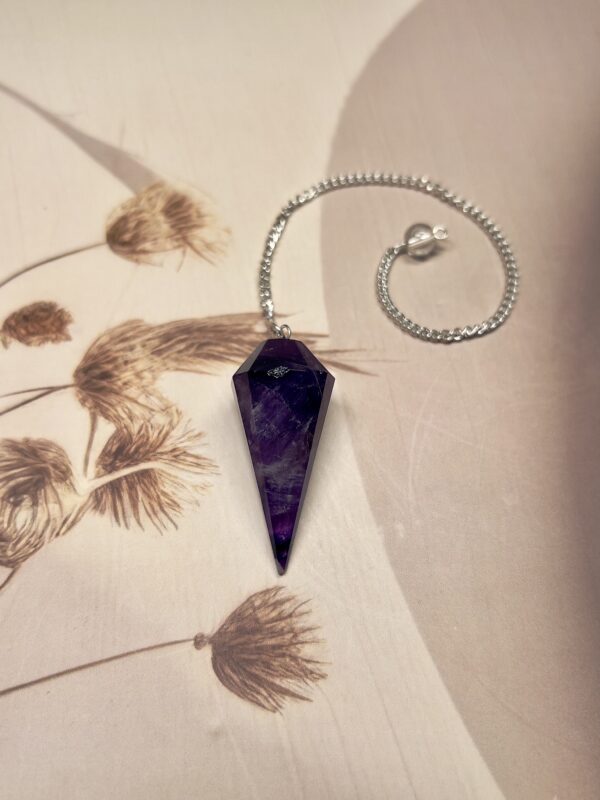
The Amethyst in this pendulum has a particularly rich purple appearance, with darker saturation concentrated through parts of the pointed body.
What Is a Crystal Pendulum Used For?
A crystal pendulum is traditionally used for dowsing, divination, intuitive reflection, meditation and spiritual practices.
The pendulum is held by the chain and allowed to hang freely while the user asks a clearly framed question and observes its movement.
For many practitioners, the most useful role of a pendulum is to create a focused framework for reflection around one specific question, rather than treating the movement as an unquestionable answer.
An Amethyst pendulum is particularly suited to reflective questions involving:
Clarity — “Am I looking at this situation objectively?”
Decisions — “Have I considered the consequences of this choice carefully?”
Self-awareness — “Am I avoiding something I already recognise?”
Emotional reactions — “Am I responding to this situation or simply reacting to it?”
Personal direction — “Does this choice fit the priorities I have set for myself?”
Habits — “Is this pattern helping me or keeping me stuck?”
Meditation — “What should I focus on during this practice?”
The movement of a pendulum can also be influenced by subtle unconscious movements of the hand, known as the ideomotor effect. For this reason, pendulum responses are best treated as a tool for personal reflection and intuition, rather than an objective method of predicting the future or obtaining independently verified information.
Traditional Amethyst Benefits
Amethyst has a particularly strong traditional identity around mental calm, clarity, reflection, intuition and meditation. It is also traditionally used as a protective stone and as a reminder to approach situations with greater self-control.
Mental Clarity
Amethyst is traditionally used when your thoughts feel crowded or difficult to organise.
It can be incorporated into reflection around questions such as:
- What actually matters here?
- Am I overreacting?
- What information am I overlooking?
- What is the simplest practical next step?
Calmer Decision-Making
Traditional Amethyst practice places strong emphasis on pausing before acting.
Rather than making a decision while overwhelmed by anger, fear or pressure, it is used symbolically to create enough space to think through the situation.
Intuition & Inner Awareness
Amethyst is traditionally associated with intuition, insight and recognising information that may be overlooked during purely analytical thinking.
For pendulum work, this makes it particularly fitting for questions that are really about understanding your own instincts, assumptions and reactions.
Meditation
Amethyst is one of the most widely used crystals in traditional meditation practices, particularly for quiet reflection, concentration and spiritual contemplation.
A pendulum can be held motionless before meditation or used as a focal object while concentrating on one intention.
Self-Awareness
Traditional Amethyst practices encourage looking honestly at your own habits, emotional reactions and decision-making patterns.
This can be useful when you are trying to understand why you keep repeating the same behaviour or avoiding the same issue.
Emotional Composure
Amethyst is traditionally associated with responding with more restraint and less impulsiveness, particularly when emotions are running high.
Protection
Amethyst has a longstanding traditional reputation as a protective crystal, particularly in spiritual practices involving personal boundaries and maintaining a centred state.
Focus & Follow-Through
Traditional crystal systems also associate Amethyst with focus, learning, putting ideas into action and completing projects, making it meaningful for study, work and long-term goals.
Evening Reflection
Amethyst is frequently incorporated into evening and bedtime rituals, especially when the intention is to quiet a busy mind and create a more settled transition away from the day’s activity.
Chakra Associations
Amethyst is most strongly associated with the Third Eye Chakra and Crown Chakra in modern crystal practice.
Third Eye Chakra — Intuition, Clarity & Awareness
The Third Eye Chakra is traditionally associated with perception, intuition, mental clarity and inner understanding.
Amethyst is commonly used here for intentions involving:
- clearer thinking
- recognising patterns
- self-reflection
- intuitive awareness
- thoughtful decision-making
- understanding your own reactions
- stepping back from emotional impulse
For pendulum work, this association is particularly relevant when the question involves what you already know or sense but have not yet clearly articulated.
Crown Chakra — Meditation, Perspective & Spiritual Awareness
The Crown Chakra is traditionally associated with meditation, broader perspective, spiritual reflection and a sense of meaning.
Amethyst is used here for:
- meditation
- contemplation
- spiritual practice
- reflection
- developing perspective
- quieting mental distractions
Third Eye + Crown Connection
Together, these two traditional associations give Amethyst a very clear direction:
Observe → understand → reflect → decide.
That makes it particularly appropriate for a pendulum designed around intuitive reflection rather than simply asking random yes/no questions.
Traditional Body & Organ Associations
Traditional crystal-healing systems associate Amethyst with the head and nervous system, with additional correspondences involving the endocrine system, lungs, circulation, digestive tract, immune system and skin. These are traditional associations and are not scientifically established medical effects.
Head & Brain
Amethyst is traditionally connected with the head, brain and mental processes, particularly through its Third Eye and Crown associations.
Nervous System
Traditional practices associate Amethyst with a calmer nervous system and reduced mental overstimulation, particularly during meditation and relaxation.
Pineal & Pituitary Regions
Some crystal-healing systems associate Amethyst with the pineal and pituitary glands, largely because of its traditional Third Eye, Crown and sleep-related symbolism.
Endocrine System
Amethyst is also traditionally associated with the endocrine system and hormonal balance within lithotherapy practices.
Lungs & Respiratory System
Traditional sources include the lungs and respiratory system among Amethyst’s physical correspondences.
Heart & Circulation
Some traditional systems connect Amethyst with the heart, blood and circulation.
Digestive System
Traditional Amethyst practices also include associations with the stomach and digestive tract.
Immune System
The immune system is another traditional correspondence found in crystal-healing references.
Skin
Some traditional systems associate Amethyst with skin and overall skin condition.
These physical associations belong to traditional crystal-healing and lithotherapy practices and should not be interpreted as medical treatment.
How to Use Your Amethyst Pendulum
Establish Your Personal Yes & No Movements
Before asking meaningful questions, hold the chain steadily and allow the pendulum to hang still.
Ask a question to which you already know the answer.
Observe the movement for “yes”, then repeat with a known “no”.
Use these movements as your own reference rather than assuming the same direction applies universally.
Ask One Question at a Time
Keep questions specific enough that you can actually reflect on the answer.
Instead of:
“What should I do with my life?”
Try:
“Would giving this project another three months support the goal I am currently working toward?”
Specific questions create a much clearer structure for reflection.
Use It for Self-Reflection
An Amethyst pendulum is particularly suited to questions involving:
- intuition
- decisions
- emotional reactions
- self-awareness
- personal habits
- priorities
- meditation
- spiritual practice
Pair It With Journaling
After the pendulum gives a response, write down your immediate reaction.
Ask yourself:
Did I feel relieved by that answer?
Did I feel disappointed?
Did I already know what I wanted the answer to be?
Those reactions can provide useful information about your own preferences and assumptions.
Meditation & Intention Setting
Hold the pendulum by its chain and allow it to remain still.
Choose one clear intention, such as:
“I respond calmly before I react.”
“I trust myself to make thoughtful decisions.”
“I communicate honestly with myself and others.”
“I focus on what genuinely matters.”
Why Amethyst Is Especially Suited to a Pendulum
The traditional symbolism of Amethyst works particularly well with pendulum practice because so much of its focus is on reflection, clarity and observing your own thoughts before taking action.
Rather than using the pendulum only for questions such as “yes or no”, you can use it as a structured prompt for examining decisions and personal patterns.
For example:
Before Making a Decision
“Have I considered the practical consequences carefully?”
When Overthinking
“Am I continuing to analyse this because I need more information, or because I am afraid to decide?”
During Emotional Conflict
“Am I reacting to what was actually said, or to what I assumed was meant?”
When Setting a Goal
“Does this goal still match my current priorities?”
During Personal Reflection
“Is there something I already know but am avoiding acknowledging?”
The pendulum does not replace your judgement. It gives you a physical, repeatable process for slowing down and examining what you already think and feel.
Amethyst & Meditation
Amethyst has an especially strong traditional relationship with meditation. It is commonly used as a focus object for quieting mental noise, maintaining attention and developing a more reflective state of mind.
The pointed form of this pendulum makes it easy to hold directly over a chosen point during a meditation or chakra practice, provided it is handled gently and kept secure.
Its deep purple colour also makes it particularly suitable for practices centred on the Third Eye and Crown Chakras.
Specifications
Product: Natural Amethyst Pendulum
Stone: Natural Amethyst
Mineral: Quartz Variety
Chemical Formula: SiO₂
Colour: Deep Purple / Violet
Approx. Length: 2 CM
Approx. Width: 2.1 CM
Approx. Height: 4.45 CM
Approx. Weight: 15 GM
Finish: Polished & Faceted
Shape: Pointed Pendulum
Primary Chakras: Third Eye & Crown
Traditional Associations: Mental Clarity, Focus, Meditation, Intuition, Self-Awareness, Emotional Composure, Protection & Thoughtful Decision-Making
Hardness: Approx. 7 Mohs
Care Guide
Amethyst is relatively durable at approximately 7 Mohs, but a pointed crystal can still chip if dropped or struck against a hard surface.
Clean gently with a soft cloth or a very lightly damp cloth, then dry thoroughly.
Avoid:
- dropping the pendulum
- striking the pointed termination
- abrasive materials
- harsh chemicals
- prolonged exposure to strong direct sunlight
- unnecessary pressure on the chain attachment
Prolonged direct sunlight can gradually fade Amethyst’s purple colour, so store it away from strong continuous UV exposure.
Keep the chain untangled and avoid pulling sharply on the attachment point.
Reviews
There are no reviews yet.