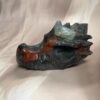
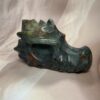
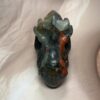
Ancient Symbolism. Earthy Mineral Character. A Powerful Collector’s Carving.
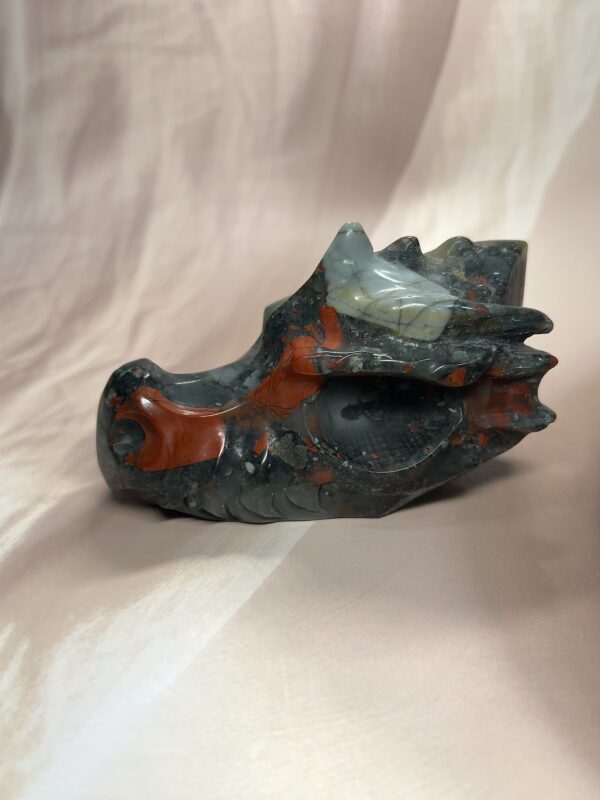
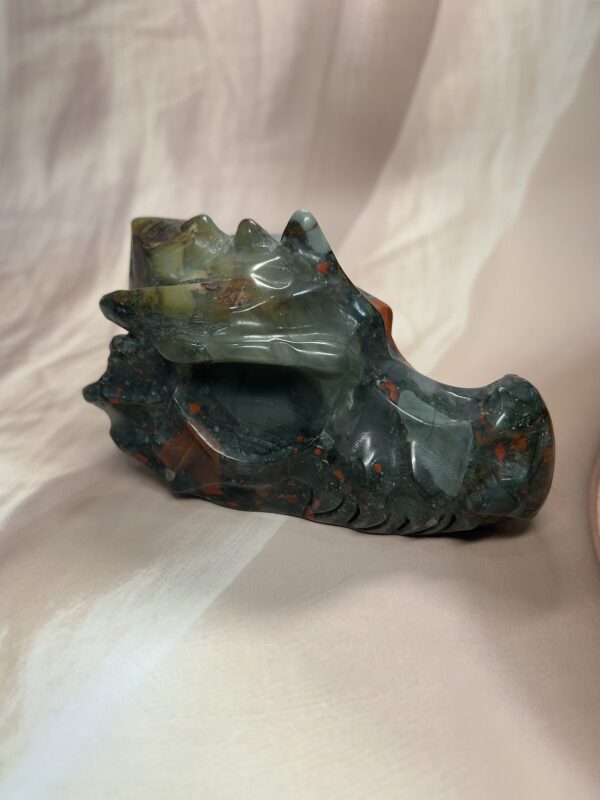
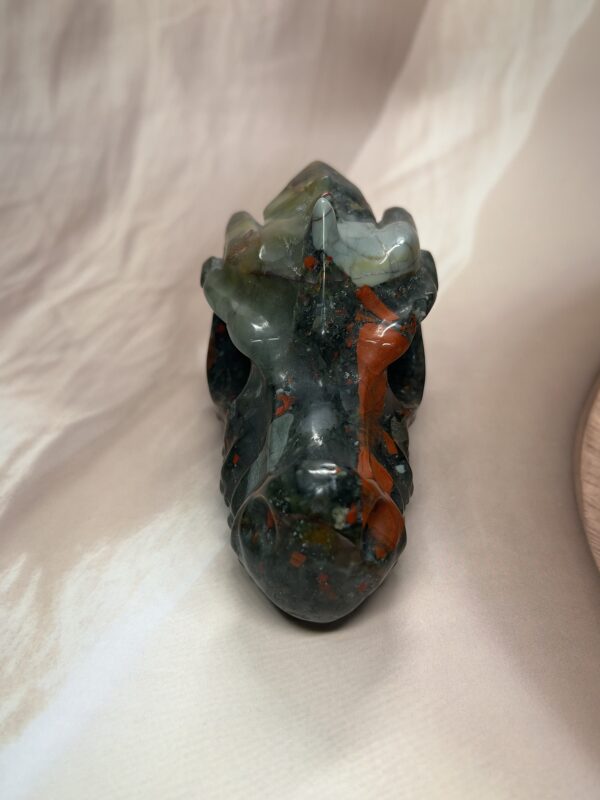
This African Bloodstone Dragon has a naturally strong presence despite its relatively compact size.
Carved from African Bloodstone, commonly traded as Setonite, the sculpture brings together an earthy mineral palette with the unmistakable form of a dragon. Setonite is commonly described in the mineral and crystal trade as a material composed of red Jasper, grey/green Chalcedony and Pyrite, rather than classic Bloodstone/Heliotrope.
That distinction matters because the material’s appearance can be considerably more varied than traditional dark-green Bloodstone.
The stone can reveal:
Green and grey Chalcedony
Red Jasper
Earthy brown and rust tones
Dark mineral areas
Occasional metallic Pyrite
This combination gives each carving its own geological character.
And the dragon is an exceptionally fitting form for such a stone.
The material itself is traditionally associated with strength, vitality, grounding and resilience.
The dragon carries centuries of symbolism connected with power, protection, courage and auspicious fortune.
The result is a carving with a very clear identity:
Grounded Strength. Protective Power.
What Is African Bloodstone?
There is an important distinction between African Bloodstone and traditional Bloodstone, also called Heliotrope.
Classic Bloodstone is a dark green variety of Chalcedony with distinctive red spots or patches caused largely by iron-oxide inclusions. GIA describes Bloodstone as a variety of Chalcedony that ranges from semi-translucent to opaque and commonly has red hematite-related inclusions.
African Bloodstone, however, is commonly used as a trade name for Setonite, a more complex mineral aggregate generally described as containing red Jasper, grey/green Chalcedony and Pyrite.
So this is not simply traditional Indian-style Bloodstone with a different geographic label.
It is a distinct and more complex material sold under the African Bloodstone / Setonite trade name.
That complexity is part of what makes the material so visually interesting.
The Mineral Composition
The exact composition can vary according to the particular Setonite material, but commercially described African Bloodstone commonly includes:
Chalcedony
A microcrystalline form of Quartz, providing the green/grey body of much of the material.
Red Jasper
Responsible for many of the earthy red, rust and reddish-brown areas.
Pyrite
Some African Bloodstone contains small metallic Pyrite inclusions, which can produce tiny brassy-gold reflective pointswithin the darker mineral matrix.
That means the stone can contain three very different visual characters within one carving:
Soft green-grey Chalcedony → warm red Jasper → metallic Pyrite
This is one reason Setonite is particularly attractive when shaped into larger carvings.
Why the Dragon Form Works So Well
The dragon is not a random decorative shape here.
It gives the mineral a strong symbolic and visual identity.
The long, serpentine body allows the natural colour variation within the stone to travel through the carving, while the head, limbs and other projecting details give the mineral a recognisable form.
Instead of looking at an abstract piece of green-and-red stone, you immediately see:
A Guardian.
A Creature of Power.
A Symbol of Strength.
And because the stone itself is already associated in modern crystal traditions with grounding and resilience, the dragon becomes particularly complementary.
The Dragon as a Symbol
Dragon symbolism varies significantly between cultures, but in Chinese traditions, dragons have historically carried associations with power, protection, happiness, fertility, prosperity and auspiciousness. The Metropolitan Museum of Art describes the dragon as a highly layered symbol that can represent protection and happiness, while its broader scholarship notes the dragon’s associations with power and prosperity.
Dragons can therefore symbolise:
- Strength
- Protection
- Courage
- Power
- Wisdom
- Guardianship
- Prosperity
- Good fortune
- Ambition
- Authority
The Met also notes that dragon imagery can function as a protective and auspicious presence.
This makes the dragon particularly appropriate as a protective display symbol within a home, office or crystal collection.
African Bloodstone — Traditional Energetic Associations
African Bloodstone/Setonite is traditionally approached as a grounding and strengthening stone.
Modern crystal traditions commonly associate it with:
- Grounding
- Vitality
- Strength
- Endurance
- Courage
- Protection
- Resilience
- Emotional stability
- Determination
- Clear action
- Renewal
Recent crystal-healing sources specifically describe African Bloodstone as being associated with the Root and Heart Chakras, combining grounded stability with emotional resilience and compassionate strength.
These are traditional crystal-healing and spiritual associations, not scientifically established effects.
Chakra Associations
Root Chakra — Muladhara
Grounding • Stability • Vitality • Courage • Physical presence
The Root Chakra is traditionally associated with feeling secure, grounded and physically present.
African Bloodstone is most strongly connected with this centre in modern crystal traditions, particularly around stamina, resilience, courage and steadiness.
The earthy green, grey and red mineral palette also fits naturally with traditional Root Chakra symbolism.
Root Message:
Stay grounded. Stay steady. Keep moving.
Heart Chakra — Anahata
Compassion • Emotional balance • Connection • Forgiveness
The green component of Bloodstone symbolism connects it with the Heart Chakra.
Here, the traditional emphasis is not simply romance—it is emotional resilience and courageous compassion.
The stone is traditionally used as a symbolic bridge between:
Grounded strength + open-hearted action.
Heart Message:
Stay compassionate without losing your strength.
Traditional Metaphysical Benefits
Grounding & Stability
African Bloodstone is traditionally used when the intention is to become more centred, steady and physically present.
Courage
Its red and earthy components are traditionally associated with bravery, determination and acting despite uncertainty.
Vitality & Endurance
African Bloodstone is commonly associated with sustained energy and the ability to continue through demanding periods rather than relying on short bursts of motivation.
Protection
Modern crystal traditions commonly use Setonite symbolically for protection and maintaining a stronger sense of energetic boundaries.
Emotional Resilience
Its Heart Chakra association is traditionally connected with processing difficult emotions while remaining grounded rather than overwhelmed.
Determination
African Bloodstone is traditionally associated with staying committed to a goal, especially when circumstances become difficult.
Clearer Action
Some modern traditions use it when the intention is to move from hesitation into deliberate action and decision-making.
Renewal
Bloodstone traditions often connect the green-and-red material with recovery, renewal and moving forward after difficult periods.
Traditional Physical & Body Associations
For customers interested in the physical correspondences found in traditional crystal-healing systems, Bloodstone traditions are particularly focused on blood, circulation, vitality and the body’s physical strength.
Because African Bloodstone/Setonite is a different mineral aggregate from classic Bloodstone, these correspondences should be understood as traditional associations applied to the Bloodstone/Setonite crystal tradition, not as established properties of the specific mineral mixture.
Blood & Circulation
Bloodstone has a very long traditional association with blood and circulation. Historical lapidary traditions specifically attributed blood-related properties to the stone, and modern crystal-healing systems continue that correspondence.
Heart & Cardiovascular Area
The Heart Chakra association also leads traditional crystal-healing systems to associate Bloodstone with the heart and circulatory system.
Physical Vitality & Stamina
Bloodstone is traditionally associated with physical stamina, endurance and maintaining energy, especially during periods of exertion or fatigue.
Immune & Defensive Function
Some modern crystal-healing traditions associate Bloodstone with the body’s defensive and rejuvenating processes, although this is a spiritual correspondence rather than an established physiological effect.
Detoxification / Cleansing
Traditional Bloodstone literature sometimes connects the stone with purification and the body’s cleansing processes. These are historical lithotherapy concepts and should not be interpreted as evidence that the stone physically detoxifies the body.
Important Health Note
There is no reliable scientific evidence that African Bloodstone/Setonite or Bloodstone improves circulation, strengthens the heart, treats blood disorders, boosts immunity, detoxifies the body, or increases physical stamina. These are traditional crystal-healing correspondences and are not medical treatments.
Why the Green + Red Combination Is Symbolically Powerful
African Bloodstone contains a particularly interesting visual combination.
Green
Traditionally associated with the Heart Chakra, compassion, balance and emotional connection.
Red
Traditionally associated with the Root Chakra, vitality, courage, physical presence and determination.
Together:
Heart + Root
Compassion With Courage.
Emotion With Stability.
Care With Action.
That dual symbolism is one of the reasons Bloodstone is traditionally regarded as a particularly grounded yet heart-centred stone.
Why the Dragon Elevates These Associations
The Dragon adds exactly what the stone’s traditional energy lacks visually: a commanding form.
African Bloodstone already represents grounded resilience within modern crystal traditions.
The dragon visually represents the guardian.
So the piece can be interpreted as:
A Guardian of Grounded Strength.
That makes it particularly appropriate as a stationary symbol in a space where the owner wants to emphasise:
Protection
Strength
Courage
Stability
Resilience
Prosperity
Purposeful action
Where to Display Your African Bloodstone Dragon
Entrance / Foyer
The dragon’s traditional guardian symbolism makes an entrance a particularly meaningful placement.
It can serve as a symbolic protective figure at the threshold of the home. Dragons have historically been used as protective and auspicious imagery in East Asian visual culture.
Living Room
The dragon can become a prominent decorative focal point while the earthy Bloodstone palette works naturally with wood, stone, brass and neutral interiors.
Workspace
The traditional associations with courage, endurance, determination and purposeful action make it particularly fitting near a work desk, office shelf or business display.
Meditation Space
The Root + Heart Chakra combination makes this a fitting object for meditation centred around:
Grounding → Emotional resilience → Courageous action
Crystal Collection
At 440 GM, this has enough weight and sculptural presence to hold its own among other mineral carvings, freeforms, geodes and statement pieces.
The Physical Character of African Bloodstone / Setonite
Commercial African Bloodstone/Setonite is described as a mineral aggregate involving red Jasper, Chalcedony and Pyrite. Depending on the particular material, hardness is commonly reported around 6–7 or approximately 6.5–7.5, reflecting the mixed mineral composition.
The Chalcedony component contributes good abrasion resistance, while the mixed aggregate can have different hardnesses and textures across the carving.
This makes the piece reasonably durable for a decorative carving but does not make the projecting details of the dragon impact-proof.
Specifications
Product: African Bloodstone Dragon Statement Piece
Trade Name: African Bloodstone / Setonite
Composition: Commonly Red Jasper + Grey/Green Chalcedony + Pyrite
Approx. Dimensions: 11 × 5.85 × 7.35 CM
Approx. Weight: 440 GM
Form: Dragon Carving
Colour Character: Green/Grey with Red, Brown, Dark and potentially Metallic Mineral Areas
Finish: Sculpturally Carved & Polished
Type: Crystal / Mineral Collector’s Statement Piece
Care & Handling
- Place the dragon on a stable, level surface.
- Support the main body when moving it.
- Do not lift it by the head, horns, tail, legs or other projecting features.
- Avoid dropping or striking the carving against hard surfaces.
- Dust gently with a soft microfiber cloth or soft brush.
- Avoid abrasive cleaning materials.
- Avoid harsh chemicals.
- Keep away from prolonged moisture, particularly around any Pyrite-bearing areas.
- Store separately from objects that could scratch or impact the polished surface.
Reviews
There are no reviews yet.