A Seven-Chakra Crystal Tool in One Beautiful Pendulum
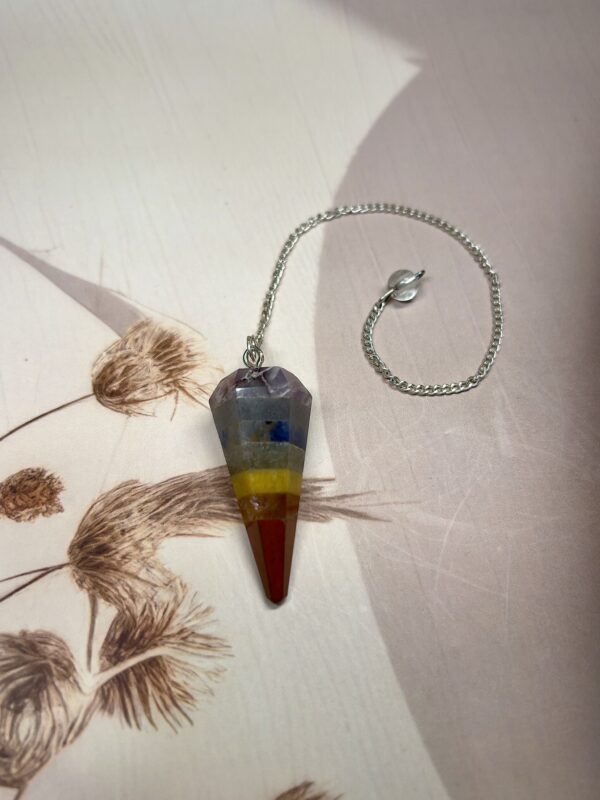
This pendulum brings seven different natural crystals together in a single elongated form, allowing you to work with the complete Root-to-Crown chakra sequence rather than carrying separate stones for each energy centre.
The colours are arranged progressively through the body of the pendulum:
Root — Red Jasper
Sacral — Red Aventurine
Solar Plexus — Yellow Aventurine
Heart — Green Aventurine
Throat — Sodalite
Third Eye — Labradorite
Crown — Amethyst
The pointed body gives the pendulum its traditional directional form, while the metal chain provides a comfortable way to hold and suspend it.
Because the pendulum contains several stones rather than one single crystal, it can be used as a whole-system chakra tool or for focusing on one particular chakra represented by the corresponding section.
The Seven Crystals & Their Traditional Associations
1. Red Jasper — Root Chakra
Red Jasper is traditionally associated with the Root Chakra, grounding, stability, physical presence, courage and steady motivation. It is often chosen when the intention is to feel more secure, organised and capable of dealing with practical responsibilities.
Traditional body associations include the legs, feet, lower back, colon, blood and general physical vitality.
For everyday life, its symbolism works well around stability, endurance, establishing routines, financial grounding and completing difficult tasks.
2. Red Aventurine — Sacral Chakra
In this pendulum, Red Aventurine represents the Sacral Chakra and adds a warmer, action-oriented element to the sequence.
It is traditionally associated with motivation, determination, creativity, confidence, perseverance and turning ideas into action. Traditional body correspondences include the circulatory system, lower back and reproductive region.
This section is especially suited to intentions around creative momentum, courage, personal drive and following through when something matters to you.
3. Yellow Aventurine — Solar Plexus Chakra
Yellow Aventurine represents the Solar Plexus Chakra in this arrangement.
Traditionally associated with confidence, personal power, optimism, decisiveness and purposeful action, it is particularly relevant to goals involving self-belief and taking initiative.
Traditional body associations connected with Yellow Aventurine and Solar Plexus practices include the stomach, digestive region, pancreas and broader metabolic area.
It is a meaningful section to focus on when working with intentions around confidence, leadership, motivation, decision-making and achieving personal goals.
4. Green Aventurine — Heart Chakra
Green Aventurine represents the Heart Chakra, traditionally associated with love, compassion, emotional balance, growth and healthy relationships.
It is often chosen when working on self-worth, emotional recovery, optimism, relationship patterns, forgiveness and staying open without abandoning personal boundaries.
Traditional body associations commonly include the heart, circulation, lungs, liver, sinuses and adrenal region.
5. Sodalite — Throat Chakra
Sodalite represents the Throat Chakra and is traditionally associated with truth, communication, logic, mental clarity and honest self-expression.
It is particularly useful symbolically for questions involving what needs to be said, how you should communicate something, whether you are expressing yourself honestly, and whether a decision matches your reasoning.
Traditional body associations include the throat, vocal cords, larynx, thyroid region and nervous system. Sodalite is also commonly used with the Third Eye in modern crystal practice because of its association with perception and insight.
6. Labradorite — Third Eye Chakra
Labradorite represents the Third Eye Chakra in this pendulum and brings the themes of intuition, observation, self-awareness, transformation and seeing a situation from a wider perspective.
Its natural labradorescence — the blue and gold flashes produced by its internal structure — also makes it particularly attractive as a visual meditation focus.
Traditional body associations include the eyes, brain, nervous system and upper mental/perceptive faculties.
This section is particularly suited to reflection around intuition, patterns, personal direction and understanding what may be influencing a decision beneath the obvious surface.
7. Amethyst — Crown Chakra
Amethyst completes the sequence at the Crown Chakra and is traditionally associated with calm, meditation, spiritual reflection, intuition, mental clarity, self-awareness and a broader perspective.
It is also commonly used with the Third Eye, creating a natural transition between inner perception and higher reflection.
Traditional body associations include the head, brain, nervous system, endocrine region and respiratory system, although these are spiritual/lithotherapy correspondences rather than medical findings.
What Is a Crystal Pendulum Used For?
A crystal pendulum is traditionally used as a tool for dowsing, divination, intuitive reflection, meditation and spiritual practice.
It is held by the chain so that the pointed crystal hangs freely. The user then asks a clearly framed question and observes the direction and pattern of movement.
The most useful way to approach a pendulum is as a structured reflection tool rather than something that makes decisions on your behalf.
This 7 Chakra Pendulum is particularly suited to reflective questions around:
Grounding — “Am I approaching this situation from a stable place?”
Motivation — “What part of this goal am I avoiding?”
Confidence — “Am I hesitating because I genuinely need more information?”
Relationships — “Am I respecting my own needs as well as someone else’s?”
Communication — “Is there something important I am not saying clearly?”
Intuition — “Have I considered what my first instinct is telling me?”
Personal growth — “Is this choice consistent with the direction I want my life to take?”
Pendulum movement can also be influenced by subtle unconscious hand movements, commonly discussed through the ideomotor effect, so its responses are best treated as prompts for reflection rather than independently verified answers or predictions.
Working With the Seven Chakras
The greatest advantage of this pendulum is that it gives you a single tool for the entire chakra sequence.
You can use it for a full chakra-focused meditation or concentrate on one section depending on your current intention.
Root
Focus on stability, security, grounding and practical action.
Sacral
Focus on creativity, motivation, emotional movement and personal drive.
Solar Plexus
Focus on confidence, willpower, decisions and purposeful action.
Heart
Focus on love, compassion, emotional balance and healthy relationships.
Throat
Focus on truth, communication, boundaries and honest expression.
Third Eye
Focus on intuition, observation, self-awareness and perspective.
Crown
Focus on meditation, reflection, spiritual awareness and meaning.
This makes the pendulum useful not only for yes/no questions, but also as a physical focal point during chakra meditation and intention-setting.
How to Use Your 7 Chakra Pendulum
Establish Your Personal Yes & No Movements
Hold the chain lightly and allow the pendulum to become still.
Ask a question to which you already know the answer, such as:
“Is my name ____?”
Observe the movement.
Then ask a known negative:
“Is my name ____?”
Observe the second movement.
Use these as your personal reference rather than assuming that a particular direction universally means “yes” or “no.”
Ask One Clear Question at a Time
Specific questions are easier to work with than extremely broad ones.
Instead of:
“What should I do with my life?”
try:
“Would pursuing this opportunity support the goal I am currently working toward?”
The second question gives you a much clearer framework for reflection.
Use It for Chakra Reflection
Hold the pendulum over or near the corresponding chakra section during meditation and focus on one specific intention.
For example:
Root: “I am building greater stability.”
Heart: “I maintain compassion without abandoning my boundaries.”
Throat: “I communicate what I genuinely mean.”
Third Eye: “I observe this situation clearly.”
Crown: “I create space for quiet reflection.”
Combine It With Journaling
After asking a question, write down the first thought, emotion or memory that came to mind.
That immediate reaction can sometimes reveal what you were already thinking but had not clearly articulated.
Why a 7 Chakra Pendulum Is Special
Working with seven stones in one pendulum makes it convenient to move between different areas of personal practice without changing tools.
The lower sections create a practical foundation around grounding, motivation and confidence.
The middle sections focus on relationships, emotional balance and communication.
The upper sections move toward intuition, reflection and spiritual awareness.
Rather than giving every section the same role, the seven stones create a clear progression from:
Stability → Drive → Confidence → Connection → Expression → Intuition → Awareness
That makes this pendulum particularly suitable for people who want one compact tool for chakra meditation, dowsing, reflection and intention-setting.
Natural Crystal Characteristics
Because the pendulum contains several natural stones, individual sections may naturally show differences in colour intensity, translucency, inclusions, mineral texture, internal patterning and polish.
Labradorite
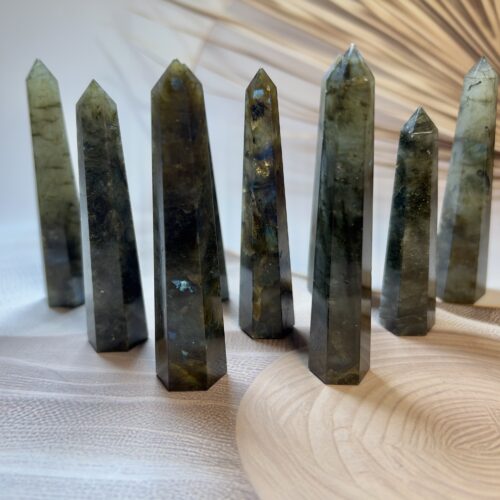
The Labradorite section may display varying amounts of blue, gold or other flashes, depending on viewing angle and lighting. This optical effect is called labradorescence and is produced by the mineral’s internal lamellar structure.
Sodalite
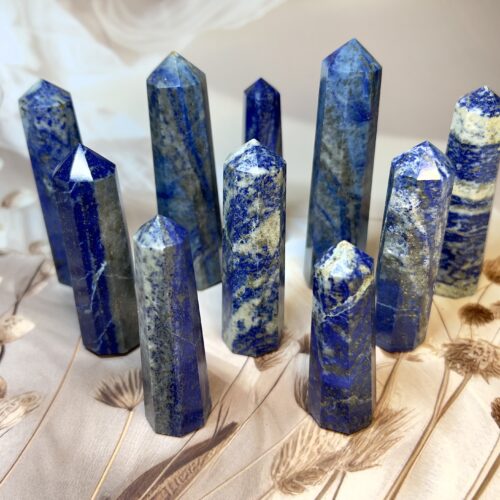
Natural Sodalite may show variations in blue colour, white mineral patterning and translucency, and the stone is relatively softer at approximately 5.5–6 Mohs.
Amethyst
Natural Amethyst may display differences in purple intensity, colour zoning, translucency and internal inclusions.
Traditional Body & Organ Associations
Across the seven stones, traditional crystal-healing systems connect the pendulum with a broad range of body areas:
Root / Red Jasper: legs, feet, lower back, colon and blood.
Sacral / Red Aventurine: lower back, circulation and reproductive region.
Solar Plexus / Yellow Aventurine: stomach, digestive system, pancreas and metabolic region.
Heart / Green Aventurine: heart, circulation, lungs, liver and adrenal region.
Throat / Sodalite: throat, larynx, vocal cords, thyroid and nervous system.
Third Eye / Labradorite: eyes, brain and nervous system.
Crown / Amethyst: head, brain, nervous system, endocrine region and respiratory system.
These are traditional crystal-healing and lithotherapy correspondences, not scientifically established effects and not substitutes for medical care.
Specifications
Product: Natural 7 Chakra Crystal Pendulum
Stone Composition: Red Jasper, Red Aventurine, Yellow Aventurine, Green Aventurine, Sodalite, Labradorite & Amethyst
Chakra Sequence: Root → Sacral → Solar Plexus → Heart → Throat → Third Eye → Crown
Approx. Length: 2 CM
Approx. Width: 2.1 CM
Approx. Height: 4.45 CM
Approx. Weight: 15 GM
Finish: Polished
Form: Pointed Pendulum
Chain: Silver-Toned Metal Chain with End Bead
Traditional Uses: Dowsing, Intuitive Reflection, Meditation, Chakra Work, Intention Setting & Spiritual Practice
Care Guide
Because this pendulum contains several different natural stones with different hardnesses, the safest care method is simple.
Clean gently with a soft, dry cloth. Avoid prolonged soaking, salt water, harsh chemicals and abrasive cleaners.
Do not use ultrasonic or steam cleaning.
Avoid dropping the pendulum or striking the pointed end against hard surfaces.
Keep perfume, lotions and other chemicals away from the crystal and metal components.
Store the pendulum separately and keep the chain untangled. When using it, hold the chain gently rather than pulling on the attachment point.
Reviews
There are no reviews yet.