The Natural Beauty of Snowflake Obsidian
Snowflake Obsidian is natural volcanic glass formed when silica-rich volcanic lava cools rapidly enough that it does not fully crystallise. The characteristic white “snowflakes” are formed by clusters of cristobalite crystals that developed within the volcanic glass during cooling.
This creates the distinctive contrast between:
Deep black volcanic glass — the main body of the stone.
White and grey Snowflake patterns — natural cristobalite crystal formations.
Irregular distribution — each area of the stone can contain different sizes, shapes and concentrations of the patterns.
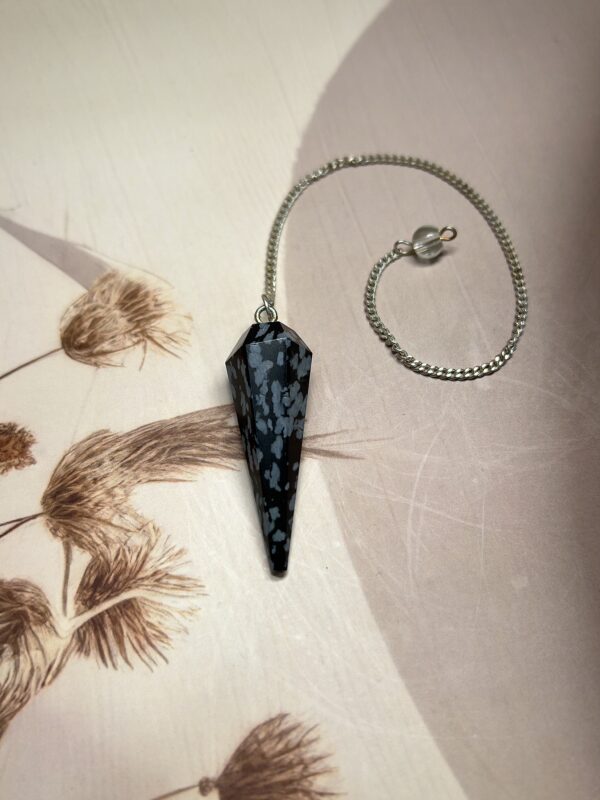
The Snowflake patterning on this pendulum is particularly attractive because it spreads across the long pointed body rather than being concentrated in just one small section.
What Is a Crystal Pendulum Used For?
A crystal pendulum is traditionally used for dowsing, divination, intuitive reflection, meditation and spiritual practices.
It is commonly held by the chain and allowed to hang freely while a practitioner asks a clearly framed question and observes the movement.
With Snowflake Obsidian, the pendulum is especially suited to reflective questions involving patterns, habits, boundaries, grounding and personal decisions.
Examples include:
Patterns — “Am I repeating the same response that has caused this situation before?”
Habits — “Is this habit still helping me?”
Relationships — “Am I ignoring a pattern that I already recognise?”
Boundaries — “Am I allowing this situation to continue because I am uncomfortable saying no?”
Decisions — “Does this choice support the direction I am trying to take?”
Self-awareness — “Am I looking at this situation honestly?”
Change — “Is there something I need to release before moving forward?”
The pendulum can help give structure to reflection around a specific question, rather than leaving the thought process completely unstructured.
Pendulum movement can also be influenced by subtle unconscious hand movements, known as the ideomotor effect. For this reason, pendulum responses are best treated as a tool for personal reflection rather than an objective method of predicting the future or obtaining independently verified information.
Traditional Snowflake Obsidian Benefits
Snowflake Obsidian has a particularly practical traditional identity: ground yourself, recognise what keeps repeating and make a conscious change.
Grounding
Snowflake Obsidian is primarily associated with grounding, stability and staying present.
It is traditionally used when you feel:
- mentally scattered
- overwhelmed by too many things at once
- disconnected from your routine
- uncertain about your next step
- pulled into repeated emotional reactions
The intention is to return attention to what is actually happening in the present.
Recognising Repeating Patterns
This is one of Snowflake Obsidian’s strongest traditional themes.
The contrasting black and white pattern is often used symbolically for recognising the parts of a situation that are easy to see and the parts that may be overlooked.
It is particularly meaningful when you notice the same:
- relationship problems
- emotional reactions
- habits
- arguments
- decision-making mistakes
- self-sabotaging behaviours
appearing repeatedly.
Emotional Balance
Snowflake Obsidian is traditionally regarded as a balancing form of Obsidian, used to help approach difficult emotions without becoming completely consumed by them.
This makes it useful symbolically when you need to pause before reacting, especially during frustration, disappointment or interpersonal conflict.
Protection
Obsidian has a long-standing traditional reputation for protection and energetic boundaries, while Snowflake Obsidian brings a more balanced and reflective emphasis.
It is commonly used as a reminder to:
protect your time,
protect your attention,
maintain your boundaries,
step away from unhealthy situations.
Letting Go of Unhelpful Habits
Traditional Snowflake Obsidian practices often focus on recognising and releasing negative behavioural patterns, self-defeating habits and thought cycles.
It is particularly relevant when you already know that something is not serving you but continue returning to it.
Self-Acceptance
Snowflake Obsidian is traditionally associated with seeing both strengths and weaknesses honestly rather than trying to hide the parts of yourself that need attention.
The practical intention is self-awareness without unnecessary self-judgement.
Calm & Composure
Its grounding symbolism also makes Snowflake Obsidian popular for situations where you need to slow your response, think clearly and remain composed.
Moving Through Change
Snowflake Obsidian is traditionally used during transition because its symbolism focuses on accepting what needs to change while remaining grounded throughout the process.
Chakra Associations
Snowflake Obsidian is most strongly associated with the Root Chakra, with a secondary traditional connection to the Third Eye Chakra. Some systems also incorporate it into broader Crown or Heart practices.
Root Chakra — Grounding, Stability & Protection
The Root Chakra is the principal association for Snowflake Obsidian.
It is traditionally connected with:
- stability
- security
- grounding
- resilience
- physical presence
- feeling anchored during uncertainty
Snowflake Obsidian is commonly used when your priority is to feel more settled before trying to work through deeper emotional or intuitive questions.
For a pendulum, this makes it particularly useful for questions about stability, habits, boundaries and practical decisions.
Third Eye Chakra — Self-Reflection & Pattern Recognition
Snowflake Obsidian is also commonly associated with the Third Eye Chakra, particularly for introspection, recognising recurring patterns and looking at a situation more honestly.
This association is especially relevant to pendulum work because the tool itself is used for focused questions and reflection.
The Root + Third Eye combination creates a practical traditional theme:
Stay grounded → observe clearly → recognise the pattern → decide what to change.
Traditional Body & Organ Associations
Traditional crystal-healing systems associate Obsidian and Snowflake Obsidian with several physical areas. These are traditional lithotherapy correspondences rather than medically established effects.
Skeletal System
Obsidian traditions include associations with the bones and skeletal structure.
Circulation & Blood Flow
Some traditional systems associate Snowflake Obsidian with blood circulation and veins.
Skin
Traditional crystal practices also connect Snowflake Obsidian with the skin, particularly within cleansing and balancing practices.
Eyes
Some traditional systems associate Snowflake Obsidian with the eyes and visual awareness.
Hormonal & Menstrual Balance
Traditional lithotherapy references also associate Snowflake Obsidian with hormonal balance and the menstrual cycle.
These are traditional correspondences and should not be understood as treatment for any physical condition.
How to Use Your Snowflake Obsidian Pendulum
Establish Your Personal Yes & No Movements
Hold the chain comfortably and allow the pendulum to hang completely still.
Ask a question to which you already know the answer and observe the movement.
Repeat the process with a known “no”.
Use these movements as your personal reference, rather than assuming that a particular direction means the same thing for everyone.
Ask One Question at a Time
Keep the question specific.
Instead of:
“What should I do with my life?”
Try:
“Would continuing with this routine support the goal I am currently working toward?”
Specific questions are easier to use as structured prompts for reflection.
Use It for Pattern Recognition
Snowflake Obsidian is particularly suited to questions about:
Habits
“Is this behaviour still useful to me?”
Relationships
“Am I ignoring a repeated pattern?”
Boundaries
“Am I agreeing because I genuinely want to?”
Decisions
“Does this choice fit the priorities I have already set?”
Personal Growth
“Is there an old reaction I need to stop repeating?”
Pair It With Journaling
After using the pendulum, write down your immediate reaction.
Pay attention to whether the answer makes you feel:
- relieved
- disappointed
- resistant
- hopeful
- certain
- confused
That reaction can be valuable because it may reveal what you already suspected but had not clearly acknowledged.
Grounding Meditation
Hold the pendulum by the chain while sitting comfortably.
Focus on the weight of the stone, slow your breathing and bring your attention back to the present whenever your thoughts wander.
Snowflake Obsidian is traditionally suited to meditation focused on grounding, emotional balance and honest self-reflection.
Why Snowflake Obsidian Is Especially Suited to a Pendulum
Pendulums are often used to ask simple questions, while Snowflake Obsidian’s traditional symbolism centres on examining what is already happening and identifying what needs to change.
That makes the pairing particularly useful for reflective questions such as:
When You Keep Repeating the Same Mistake
“Is there a pattern here that I am avoiding?”
Before Setting a Boundary
“Am I agreeing because I genuinely want to, or because I am uncomfortable saying no?”
During a Relationship Problem
“Have I experienced this same pattern before?”
During a Major Decision
“Does this decision support the direction I have chosen?”
During Personal Change
“Is something from the past still influencing this decision?”
The pendulum does not need to make the decision for you. Its traditional use can instead provide a clear, physical framework for slowing down and examining your own response.
The Snowflake Symbolism
The white Snowflake patterns against the black Obsidian body are traditionally interpreted as a symbol of balance between contrasting aspects.
Dark and light.
Strength and vulnerability.
What you acknowledge and what you still need to examine.
Change and stability.
That symbolism fits particularly well with Snowflake Obsidian’s traditional emphasis on self-awareness, accepting imperfections and recognising patterns without losing your grounding.
Specifications
Product: Natural Snowflake Obsidian Pendulum
Stone: Natural Snowflake Obsidian
Material: Natural Volcanic Glass with Cristobalite Snowflake Patterns
Colour: Black with White-to-Grey Snowflake Patterning
Approx. Length: 2 CM
Approx. Width: 2.1 CM
Approx. Height: 4.45 CM
Approx. Weight: 15 GM
Finish: Polished & Geometric Faceted
Point: Yes
Chain: Metal Chain with Small Clear End Bead
Primary Chakra: Root
Secondary Traditional Chakra: Third Eye
Traditional Associations: Grounding, Protection, Balance, Self-Reflection, Pattern Recognition, Emotional Composure, Change & Personal Growth
Hardness: Approx. 5–5.5 Mohs
Care Guide
Snowflake Obsidian is a relatively soft volcanic glass, around 5–5.5 Mohs, so the polished surface can scratch if it comes into contact with harder minerals or abrasive materials.
Clean the pendulum gently with a soft, lint-free cloth. A brief rinse with lukewarm water can be used when necessary, followed by thorough drying.
Avoid:
- dropping the pendulum
- sharp impacts
- abrasive materials
- harsh chemicals
- prolonged soaking
- very hot or very cold water
- placing it directly against harder crystals
Sudden temperature changes can be undesirable for volcanic glass, so avoid exposing the stone to extreme heat or rapid temperature changes.
Keep the pendulum separately from harder crystals to minimise scratches.
Store the chain untangled and avoid pulling sharply on the attachment point.



Reviews
There are no reviews yet.