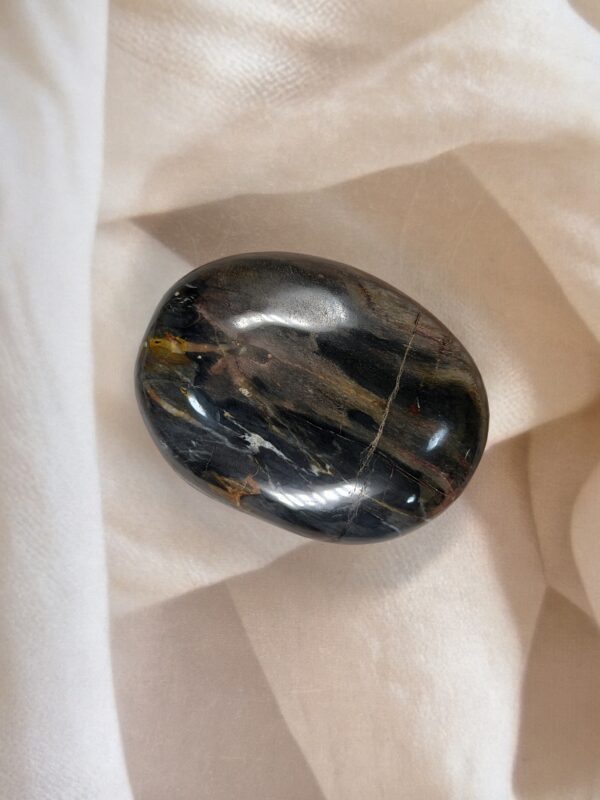
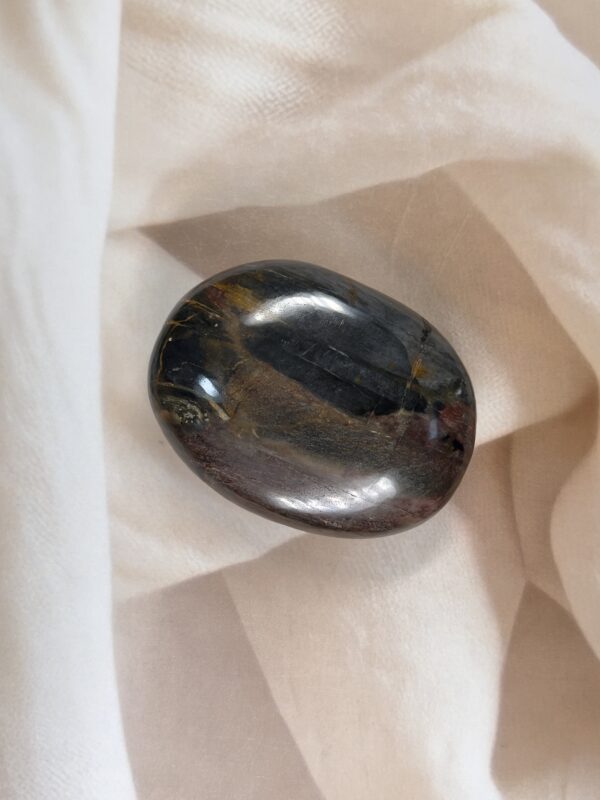
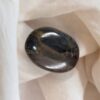
Natural Petrified Wood Palm Stone • 152 GM
You Aren’t Holding a Crystal. You’re Holding Ancient Wood Turned to Stone.
This is one of those pieces that becomes more fascinating the longer you look at it.
At first, it appears to be a beautifully polished natural stone.
Then you realise what you’re actually looking at:
A piece of ancient wood whose original structure was preserved while minerals transformed it into stone.
Our Natural Petrified Wood Palm Stone brings this extraordinary geological story into a beautifully tactile form. Smoothly polished into a generous palm-friendly shape, it retains the organic character that makes petrified wood so fascinating—natural patterns, mineral colour variations, and structures inherited from the original plant material.
Measuring approximately 5.2 × 2.53 × 6.8 CM and weighing 152 GM, it has a wonderfully satisfying presence in the hand. It is substantial enough to feel like a serious collector’s piece while remaining comfortable for meditation, reflection, or simply turning over in your palm and examining its ancient details.
This isn’t a gemstone that was simply formed underground.
It began as something alive.
The Incredible Formation of Petrified Wood
Petrified wood is a type of fossilised wood created through mineralisation.
When wood becomes rapidly buried under sediment, volcanic ash, or other deposits, the burial environment can protect it from ordinary decay. Over long periods, mineral-rich groundwater can move through the tiny pores, vessels, and microscopic spaces within the wood. Silica and other minerals are deposited into these spaces and can gradually replace or replicate parts of the original woody structure.
This process is known as silicification when silica is the principal mineral involved.
What makes the process remarkable is that the mineralisation can preserve incredibly fine details of the original wood—including cellular and structural features that can remain visible even after the organic material itself has largely been replaced.
So while the original tree or branch is long gone, its structure can survive in stone.
That is what makes petrified wood so special.
A Fossil With a Story
The colours and patterns found in petrified wood are also part of its geological story. Different trace minerals can contribute different colours during fossilisation, while variations in the original wood structure and the mineralisation process create distinctive patterns from specimen to specimen.
You aren’t simply buying a polished rock.
You’re holding a preserved chapter of Earth’s botanical history.
What Makes This Palm Stone Special
The palm-stone form brings a remarkable fossil material into a format that is both collectible and deeply tactile.
Its substantial 152 GM weight gives it a satisfying presence in the hand, while the smooth polished surface allows you to explore the natural patterns and mineral variations without the roughness of a raw fossil specimen.
Each piece can reveal:
- Ancient wood structure preserved in stone
- Organic-looking mineral patterns
- Natural earthy colour variations
- Fossilised grain and structural character
- Silicified mineral formations
- Smooth high-polish finish
- A completely unique geological composition
No two pieces of petrified wood are ever exactly alike because each originated from different organic material and experienced its own geological history during burial and mineralisation.
The Beauty of Ancient Wood
Perhaps the most captivating aspect of petrified wood is the contrast it contains.
It looks like stone.
But its patterns belong to wood.
You can see the remnants of an ancient biological structure while holding a material that has become mineralised over geological time. In silicified wood, silica may occur as chalcedony, quartz, opal, or combinations of silica phases depending on how the fossil formed.
This gives petrified wood an appearance that can feel almost impossible at first glance—organic and geological at the same time.
That duality is what makes it such a fascinating addition to a natural history or crystal collection.
Traditional Symbolism & Crystal Practices
Unlike traditional gemstones, Petrified Wood is fundamentally a fossil material, so its appeal extends beyond conventional crystal symbolism.
Within modern crystal and metaphysical traditions, Petrified Wood is commonly associated with:
- Grounding
- Stability
- Patience
- Resilience
- Connection with nature
- Ancient wisdom
- Personal growth
- Endurance through change
Its symbolism comes naturally from its geological story: something once living, buried by the Earth, transformed over vast stretches of time, and preserved as stone.
Because of this, it is often used symbolically as a reminder that growth can be slow, change can take time, and strength can develop quietly.
Crystal and metaphysical associations are based on traditional and modern spiritual practices and are not scientifically proven.
A Stone of Deep Grounding
Petrified Wood is particularly beloved by those who enjoy the symbolism of being rooted.
The original material was literally part of a tree, and its mineralised form still carries the visual memory of wood. This makes it a naturally meaningful object for rituals or practices centred around:
Grounding
A symbolic reminder to remain connected, steady, and present.
Patience
Reflecting the immense amount of time required for natural mineralisation to occur.
Resilience
A powerful metaphor for transformation—organic material becoming something enduring and stone-like.
Connection With Nature
A tangible reminder that the boundary between life, geology, and time is far more fascinating than it first appears.
Personal Growth
Often used symbolically to represent growing stronger through experiences rather than rushing the process.
Why You’ll Love This Palm Stone
This isn’t just another polished palm stone.
It has a story that began long before humans ever existed.
At 152 GM, it feels substantial and satisfying in the hand, while its polished form makes it easy to display or incorporate into your daily rituals.
Perfect for:
- Fossil collections
- Crystal and mineral collections
- Meditation
- Grounding practices
- Mindfulness
- Nature-inspired décor
- Desk or workspace display
- Personal touchstones
- Educational collections
- Meaningful gifting
- Anyone fascinated by Earth’s geological history
It is especially beautiful for collectors who appreciate specimens that tell a story rather than simply displaying colour or sparkle.
A Truly Special Addition to a Collection
Petrified Wood occupies a fascinating space between fossil, mineral specimen, and natural artwork.
Every piece represents a different combination of original wood structure, geological environment, mineral deposition, and time.
That makes it particularly rewarding to own.
You can admire it as a beautiful palm stone.
You can appreciate it as a fossil.
Or you can simply hold it and think about the extraordinary journey required for a living piece of wood to become a stone that survives for us to discover millions of years later.
This is nature’s way of turning time into an object.
Product Details
Material: Natural Petrified Wood / Fossilised Wood
Product Type: Palm Stone
Approx. Dimensions: 5.2 × 2.53 × 6.8 CM
Approx. Weight: 152 GM
Finish: Smooth Polished
Formation: Naturally mineralised / silicified fossil wood
Character: Natural and individually unique
Care & Handling
The hardness of petrified wood depends on its mineralisation. Silicified wood containing chalcedony or quartz is commonly around 6.5–7 on the Mohs scale, although fossil wood can vary depending on its exact mineral composition.
To preserve your palm stone:
- Avoid dropping it onto hard surfaces.
- Wipe gently using a soft, dry cloth.
- Avoid harsh chemicals and abrasive cleaners.
- Do not use ultrasonic or steam cleaners.
- Store separately from harder mineral specimens to protect its polish.
- Keep it somewhere secure where it will not be knocked or scratched.

Reviews
There are no reviews yet.